
ACE 2026 focused less on spectacle and more on clarity.
Across sessions—from Lauritsen to guest speaker Pınar Seyhan Demirdag, Generative AI expert and Co-Founder and CEO of Cuebric—a consistent position emerged: AI amplifies the foundation already in place.
Lauritsen described the current moment as an AI-driven revolution. A shift of this magnitude exposes the strength—or weakness—of existing data, processes, and systems.
Most organizations continue to operate across fragmented environments. Engineering, simulation, manufacturing, and supply chain data remain distributed, with a persistent layer of unmanaged information in spreadsheets and email. Introducing AI into this landscape increases speed while making these gaps more visible.

This perspective aligns with themes explored ahead of the conference in “Adaptive Intelligence: Rethinking PLM in the Age of AI & Digital Thread,” edited by Lionel Grealou, Director and Business Advisor at Xlifecycle Ltd. The book, sponsored by Aras, brings together ten practitioner perspectives spanning industries and leadership roles. It frames intelligence as the ability to connect decisions, data, and context across the product lifecycle. A physical copy was distributed to all ACE attendees. A digital version will follow.
ACE 2026 echoed these themes in a more operational context.
AI reflects the system it operates in
Lauritsen addressed a point often simplified in broader discussions: AI produces outputs that mirror the structure of the underlying data.
When data is fragmented, outputs remain incomplete. When context is missing, interpretation becomes uncertain. Speed increases, but coherence does not.
Most organizations still operate across disconnected systems:
- PLM managing product structures
- Simulation tools evolving in parallel
- Manufacturing systems capturing execution
- Informal workflows persisting outside governed platforms
In this context, AI surfaces insights within each domain, but struggles to connect them.
Lauritsen’s core message was direct: value emerges when data is connected into a true digital thread. That includes traceability, cross-system relationships, and contextual support for reasoning.
The outcome is a shift from partial insights to decision-ready intelligence.
The digital thread as execution infrastructure
The digital thread is often described conceptually. At ACE, it was positioned as execution infrastructure.
This reframing matters. A digital thread ensures that decisions remain connected across time, systems, and disciplines. It preserves meaning as products evolve.
Traceability sits at the center of this capability. Understanding who changed what, and why, enables decisions to be interpreted, validated, and trusted. This extends beyond compliance. It defines whether AI outputs can be used with confidence.
In practice, this extends beyond tooling into behavior—traceability only holds if teams consistently capture intent, decisions, and changes as part of their way of working. In this context, PLM evolves into a system that maintains decision continuity across the lifecycle.
From data to decisions: adaptive PLM
Igal Kaptsan, SVP Product Management at Aras, focused on how Adaptive PLM enables decision-making rather than simply managing data. His emphasis was on exploring “what-if” scenarios and assessing their impacts before decisions are made, enabled through semantic relationships across systems.
This capability depends on:
- Semantic relationships across product, process, and system data
- Connected models spanning engineering and manufacturing
- The ability to simulate consequences prior to execution
The shift is significant. AI becomes part of a decision system that evaluates outcomes in advance.
Adaptive PLM, in this framing, enables organizations to understand the impact of change before committing to it.
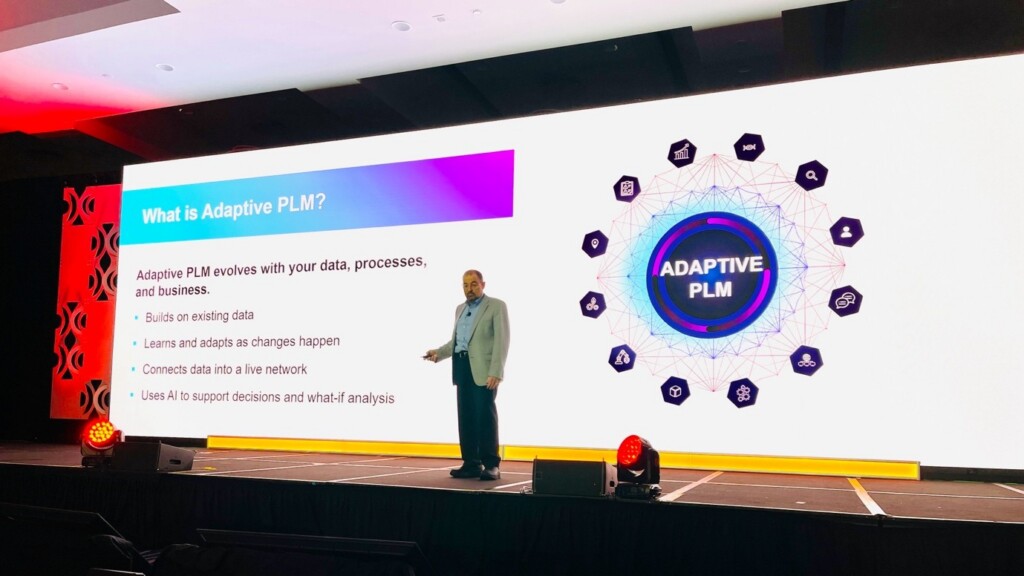
While Adaptive PLM is increasingly positioned as an operating model, a gap remains in how organizations define and measure decision quality. What constitutes a good decision loop, how impact is quantified, and how feedback is embedded systematically are still evolving areas.
Design agents within context
The discussion on AI agents brought a pragmatic perspective.
Enterprise environments are inherently specific. Data models, workflows, and constraints differ across organizations. Agents therefore require:
- Alignment with enterprise data structures
- Integration into governed workflows
- Consistency with security and access controls
A key implication emerges around access. AI agents must operate within the same boundaries as users. Any divergence introduces architectural-level risk. This places governance and design at the center of AI deployment.
Openness at the platform level introduces a new challenge: not integration, but orchestration—ensuring that expanded ecosystems do not fragment decision coherence.
From assistance to execution
One of the most consequential demonstrations at ACE moved beyond conversational interfaces. It showed an agent capable of interpreting a requirement—such as a regulatory constraint—then generating the corresponding data model and workflows and implementing them within a PLM environment.
At scale, this represents a structural shift. The impact extends beyond productivity improvements. It reduces the effort required to implement and evolve PLM systems, with estimates suggesting a 30-40% reduction.
In this context, AI becomes part of the execution layer.

Human intelligence as the control layer
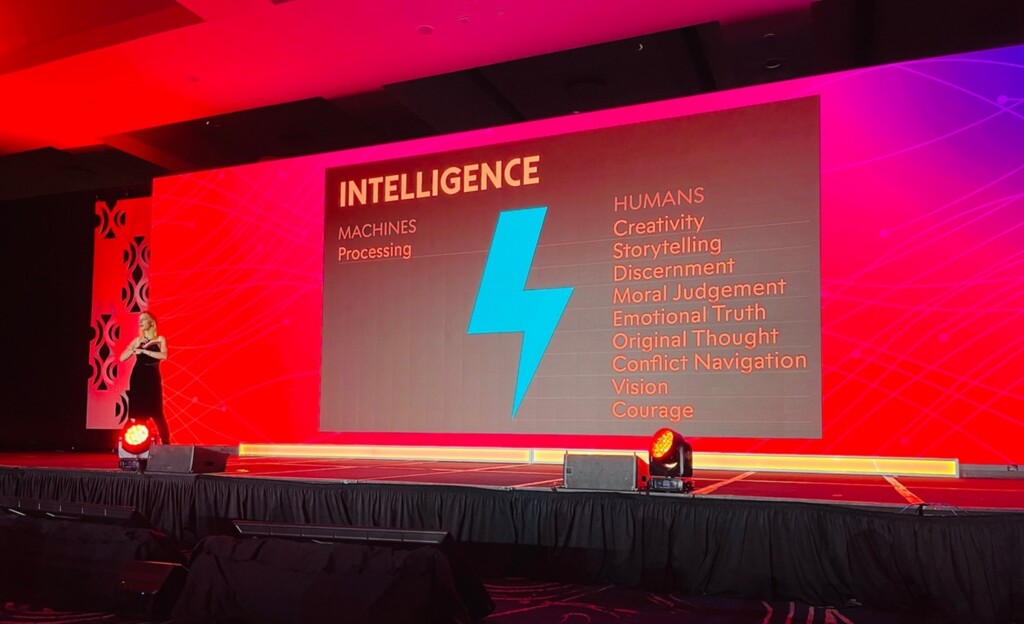
Pınar Seyhan Demirdag introduced a complementary perspective focused on human capability. Her statement was precise: “AI’s are not intelligent (…) they just mimic intelligence by spotting patterns.”
AI generates outputs based on learned patterns. Interpretation, validation, and accountability remain human responsibilities. The point is not to diminish AI. It is to define its boundary. Generative systems operate on patterns. They lack intent, judgment, or accountability.
She extended that argument further: “As machines become more capable, humans should become more human.” Her key message was clear: humans must challenge and validate assumptions.
As AI capabilities expand, human value shifts toward:
- Interpreting context
- Questioning outputs
- Validating decisions
This defines the control layer of AI-enabled systems.
The constraint is organizational
Lauritsen concluded with a point that anchored the discussion: Technology is available. Platforms can be deployed. AI capabilities can be integrated.
The primary constraint lies within the organization. Silos of ownership, fragmented accountability, and resistance to change hinder alignment across data, processes, and systems.
Many organizations advocate a “people-first” approach. The challenge lies in translating that principle into aligned ways of working supported by coherent systems and data structures. Without that alignment, complexity increases.
A more grounded path forward
ACE 2026 clarified the conditions under which AI creates value.
Three structural realities stand out:
- AI is part of an AI-driven revolution, amplifying existing foundations
- Adaptive PLM enables what-if reasoning and impact assessment before decisions
- Human intelligence focuses on challenging and validating assumptions
The shift underway is not from PLM to AI, but from engineering control to business-aligned decision systems.
Organizations that benefit will align data, process, and architecture with clear decision ownership. The question is less about the speed of adoption. It is about the ability to turn AI into meaningful, decision-ready intelligence.