
AI has shaken up one industry after the next. Engineers, however, have remained cautious of AI tools like large language models (LLMs). Sounding confident and persuasive, LLMs frequently generate answers with little grounding in reality.
But startup Acme Space claims it’s found a solution to the problem of AI hallucinations. The U.K.-based aerospace company is fully harnessing LLMs for creative engineering work, including the design of a balloon-launched orbital factory vehicle called Hyperion.
What’s the secret? Acme doesn’t just use one AI system—it uses three. By having successive stages of AIs check each other’s work, and human engineers to complete the final design, Acme says it has dramatically shortened development timelines with a fraction of the engineers of a traditional aerospace company.
“In traditional aerospace, the cycle is design – build – test – fail – redesign. One cycle takes six months,” Acme Space founder and CEO Tomas Guryca told Engineering.com. “With our AI, the cycle is design – AI simulate – fail – AI redesign. And one cycle takes 10 minutes.”
Designing Hyperion with a multi-agent AI system
Guryca founded Acme Space in 2024 with a team of experienced space engineers. The startup won last year’s NASA Lunar Challenge with a concept system that recycles waste on the moon.
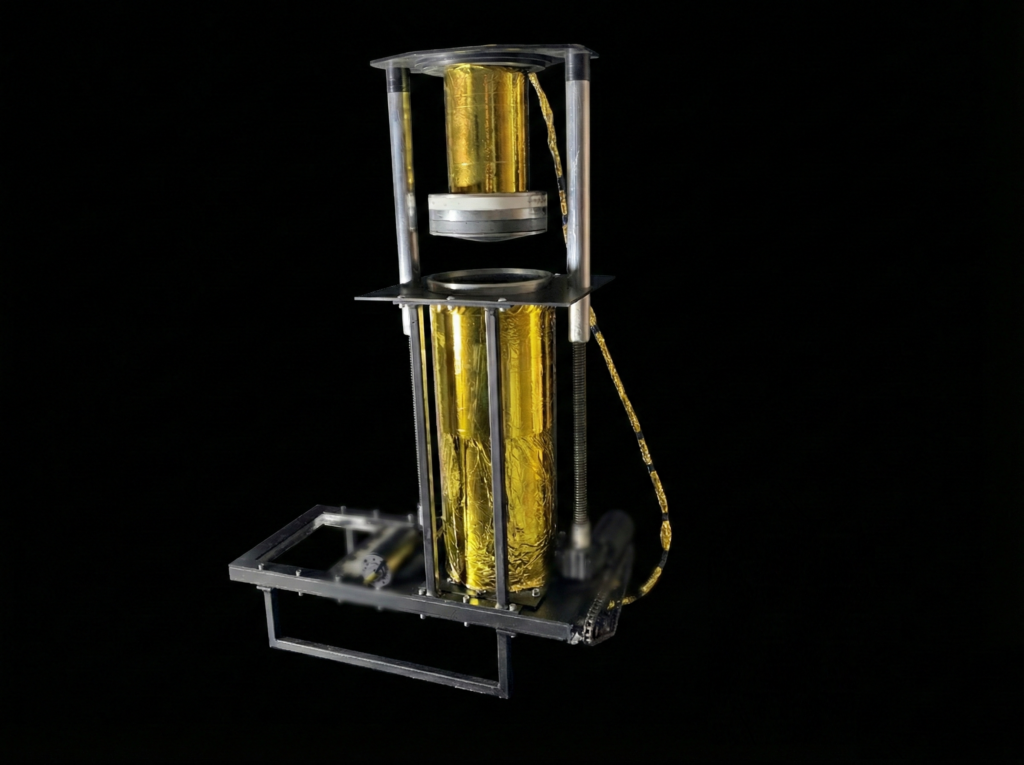
Acme Space’s other focus is the Hyperion orbital factory vehicle. Designed to launch from a stratospheric balloon, the Hyperion is a reusable spacecraft that can deliver payloads and produce materials in orbit, such as protein crystals that could enable the production of super-efficient semiconductors and optical fibers that could power future computing and communication infrastructure.
Hyperion was designed from the ground up with AI, according to Acme Space. To skirt the problem of AI hallucinations, the company created a multi-agent system of three different AI models which check each other’s work to filter out hallucinations.

Acme Space says it used that AI to design Hyperion in less than two years, an accomplishment unheard of in the space industry, known for significant delays and cost-overruns. The company plans to begin test flights later this year.
The AI dream team
Acme Space’s AI triple-agent system consists of a Hybrid Sparse Dense Retriever (HSDR) based on Meta’s open-source Llama 3 LLM, a Fourier Neural Operator (FNO) trained on complex physics equations, and a “system consistency guardian” which ensures that the solutions proposed by the other two agents can be manufactured and fit the constraints set by human engineers.
“Agent one dreams, agent two calculates the physics and agent three ensures strategy and fit,“ said Guryca.
The creative Llama-based HSDR does most of the design heavy lifting. The AI scours publicly available online libraries of patents containing information about space systems developed since the Cold War era space race and combines them with the latest in material and technology research to produce novel solutions. Guryca said it took months to train the model, which had to learn how to digest faded blueprints from 1960s NASA PDFs.
But even with all this training, hallucinations are still a big problem.
“In engineering, the cost of a confident, wrong answer is measured in recalls, regulatory issues, and sometimes lives and loss of property,” Diego Tamburini, CIMdata’s director of AI in PLM, told Engineering.com. “There is no room for wrong answers.”
Guryca admits that the Llama-based HSDR dreams way too much. Although it’s been specifically trained on highly specialist data sets, up to 80 percent of its “raw ideas” are “physically unfeasible.”
“We get a lot of designs that are impossible to create,” Guryca said. “The AI uses a lot of alien logic that defies convention.”
That’s where the second AI agent, the Fourier Neural Operator, comes in. The FNO evaluates the physical feasibility of the designs proposed by the HSDR. Developed by Acme using proprietary data sets, the FNO had to be trained on complex physics such as the behaviour of cryogenic fluids used in rocket propulsion systems. “It required months of continuous compute time on our GPU cluster,“ Guryca said.
The back-and-forth between the HSDR and FNO filters out 98% of hallucinations, Guryca said, and the rest is caught by human engineers at the end of the process.
“The second model tries to find the weak spots and mistakes in the argumentation of the first model,“ said Guryca. “It might, for example, say that the material chosen by the first model wouldn’t work because it’s not thick enough. Then the first model would create a new calculation and a new design, and this continues until both models agree.”

Once the first two AI agents settle on a solution, the third evaluates whether it’s feasible to produce. It rejects costly and complex manufacturing methods, such as metal 3D printing, in favour of simple parts and techniques. It also ensures that the design requires only standard, easily accessible components that require minimal fine-tuning. As Guryca puts it, the AI is trained to strictly adhere to the K.I.S.S. principle—keep it simple, stupid—formulated by legendary aircraft designer Kelly Johnson.
“We didn’t just train it on geometry, but on supply chain logic,” said Guryca. “We fed it industrial catalogs and manufacturing cost models, and then we used a reinforcement learning approach whereby the AI received a “reward” for using a catalog component and a “penalty” for proposing custom machining time.”
AI alone is still not good enough
Finally, when all three AI agents are happy, Acme Space’s human engineers step in to finish the work. AI is still bad at generating accurate technical drawings, according to Guryca, so Acme’s AI system presents its design proposals in the form of precise text descriptions which the engineers convert into drawings.
“To build prototypes, we really need 100 percent precision. The AI just makes too many mistakes so that it’s better and faster to have normal engineers create the drawings based on the text from the models,” Guryca said.
Still, the multi-agent AI system reduces the number of people Acme Space needs by a factor of five.
“To achieve our current pace of development with a traditional approach, we would need a team of approximately 50 to 60 senior engineers,” said Guryca. “Currently, we operate with a core team of less than ten.”
Guryca described the role of the AI system as that of a chief engineer providing specs and parameters. The human team ensures the chief got it right, then turns his ideas into the final CAD drawings.
“The human solves how to build it, the AI solves what to build,” Guryca said.
He added that because the final AI agent optimizes the design for manufacturing simplicity, the subsequent prototypes can be built using standard CNC machinery instead of costly metal 3D printing.
A new spin on an old idea
With it’s extensive training data, Acme Space’s AI system has unearthed some unorthodox ideas. For instance, Guryca said it was the AI’s suggestion to launch the Hyperion orbital factory vehicle from a stratospheric balloon.
“We tasked the system to find the most efficient path to orbit for our specific payload constraints without the massive lead times and infrastructure costs of a traditional ground launch,“ Guryca said. “The AI identified the balloon-assist method as the optimal hack. It allows us to bypass the dense, turbulent lower atmosphere and start the rocket engine in near-vacuum conditions.”
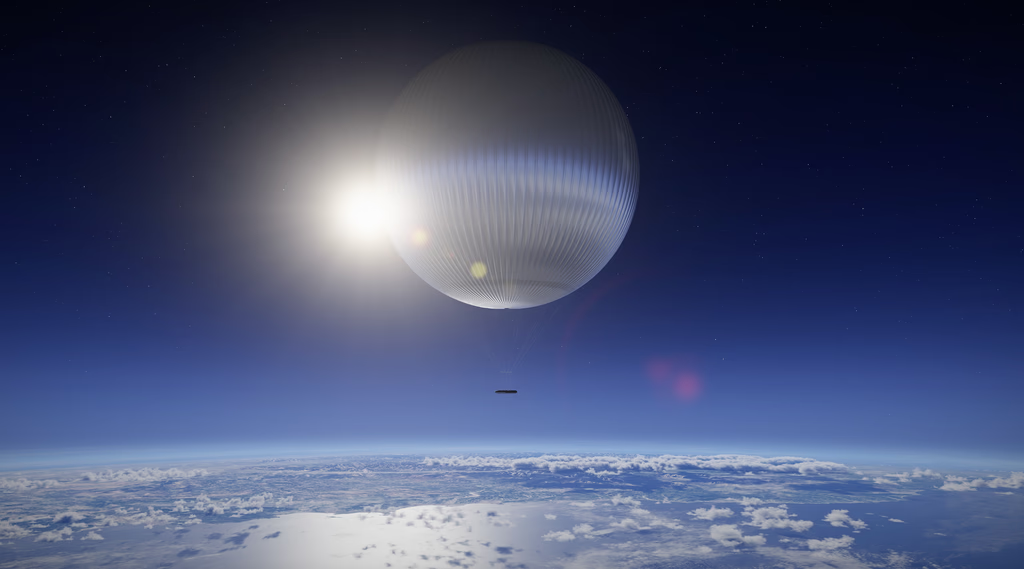
Such a solution was previously explored by Spanish startup Zero2Infinity, which struggled to raise funding for their innovative launcher. While the Spanish company aimed to sell launches to commercial satellite operators, Acme Space plans to offer space inside their orbital factory to manufacturers of semiconductors, optical fibers and pharmaceuticals, who are keen to experiment on producing novel materials in the microgravity environment.
Acme Space plans to conduct drop tests in Namibia in the first half of 2026, with the first orbital flight tests planned for the end of 2026 from the SaxaVord spaceport in the U.K.