
In an interview with EEWorld, Ethernet Evangelist John D’Ambrosia explains the profound effects that AI is having on data communications and how the optical communications industry is coping with them.
While everyone talks about AI, none of that matters without data centers to store and process the data that AI creates. Without the ability to move data fast enough to meet demands, the data center is useless. Ethernet is the force behind moving that data, both in electrical and optical transmissions. AI is pushing data communications like never before, but how?
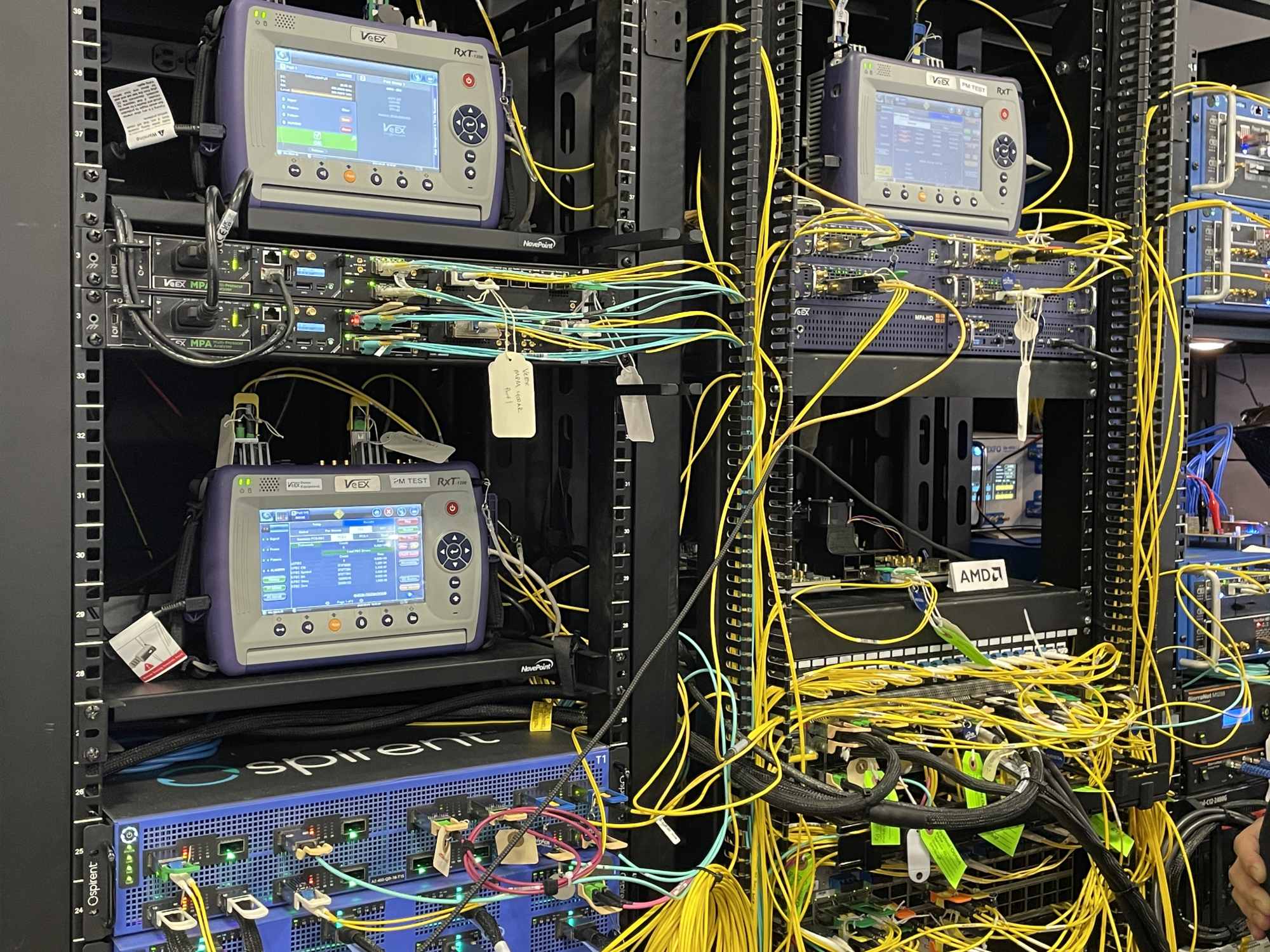
The Ethernet Alliance booth at OFC 2025 included a complete network to demonstrate interoperability.
Ethernet running at 800 Gbps (800G) is being deployed at large data centers. Of course, that speed is not nearly fast enough, which is why you may hear about 1.6 Tbps (1.6T), which is in development. Currently, 800 G is made from four 200G lanes and uses PAM4 modulation. The electrical folks speak of 224 Gbps PAM4, the full data rate, which includes forward error correction (FEC) overhead. The call for 400G per lane is drawing near.
Who drives standards development? The Ethernet Alliance spearheads the effort, along with IEEE. Presently, the effort to standardize 200G per lane is written into IEEE 802.3dj, IEEE Draft Standard for Ethernet Amendment 13: Media Access Control Parameters for 1.6 Tb/s and Physical Layers and Management Parameters for 200 Gb/s, 400 Gb/s, 800 Gb/s, and 1.6 Tb/s Operation.
To get the latest on standards and how AI affects data communications, I spoke with Ethernet Evangelist John D’Ambrosia. In the video and transcript, John keeps us up to date on the standards development, what 802.3dj contains, and how AI’s need for data also brings on power and thermal issues. They are all related.
The interview transcript
EEWorld: EEWorld. I’m senior technical editor Martin Rowe.
We can’t seem to go a nanosecond without hearing about AI. AI is straining networks, or will strain networks, just because of the huge amounts of data that need to move across those networks.
Engineers are working hard to try to keep up and bring the next generation of speeds to optical and electrical connections.
To find out what’s going on in the industry, I spoke with John D’Ambrosia, who is the Ethernet evangelist for the Ethernet Alliance. In December 2025, John participated in the Ethernet Alliance’s TEF meeting. John, can you start by first telling us what TEF stands for?
D’Ambrosia: The TEF, technology exploration forum, was a mechanism that the Ethernet Alliance developed about 15 to 20 years ago to explore future directions in Ethernet and its development. We’ve had a number of those over the years. I think we’re up to 10 at this point, and our latest was the second in a series to look at Ethernet in relation to emerging AI. AI shows up everywhere and in everything, but within communications, we hear a lot about the movement of data that AI is causing, and that spills into many things.
EEWorld: You hear about data centers, and then you hear about the electric power and the cooling, and so on. But we’re going to stick to the communications part, because all of this involves moving data. Without that. None of this happens.

Image: Meta
D’Ambrosia: Well, it does, Martin, but I think you know, as we have some of these conversations, we have to not lose sight of some of these other aspects. Power is actually a really huge challenge. And with what AI is doing and, as you said, to move more data or more bandwidth, that problem is only going to be exacerbated. And not only that, it’s getting bigger, so it does have an impact on the network. For example, as the networks have gotten bigger because of the power limitations, they’ve had to now get data centers closer together. I shouldn’t say, “closer together,” but they have data centers in different buildings that they then have to converse between each other, just because they can’t provide enough power to one data center. So it does have real impacts on the networking needs as we look forward to it. So, the AI data centers keep getting bigger and bigger. I’ve seen a graphic, I believe it was from Meta, where they were talking about a data center, an AI data center in relation to Manhattan Island. Okay, so when you think about things like that, it’s just mind-boggling, but it does stress the point that one thing does affect the other, and then we have to look at the networking as that results from those challenges.
EEWorld: I saw that same graphic. I think yesterday. Somebody may have posted it on LinkedIn. Maybe we both saw the same one, I’m not sure, but yeah, you see this building, and it covers about 50 blocks of Manhattan. That’s staggering. I think the only thing I’ve ever seen that big, would be the Boeing plant, where they build airplanes in there.
D’Ambrosia: I was at the Boeing plant years ago. It wasn’t that big.
EEWorld: I’ve been outside of the Boeing plant in north of Seattle
D’Ambrosia: Think about it, people are going to need Ubers inside of these AI data centers if they’re that big, compared to Manhattan Island. It’s just a mind-boggling concept in my head.
EEWorld: It really is okay. So that means there’s going to be lots of fiber, lots of copper, and the cooling to go with it. We’ll get to that later. But let’s look at the movement of data, and then we can discuss the implications that go along with it.
I’ve been to a number of communications conferences. OFC is one, one that I think of. Twenty years ago, we heard that data-transfer speeds weren’t fast enough. 20 years ago, we heard that even more, and now, standards tend to go double the speed every three years, perhaps four years, 20 minutes is what some people would want now. Because of that, it’s causing a lot of standards development to have to accelerate. So let’s start with the with the standards development. Where are we now, in terms of Ethernet standards that are being pushed by AI?
 D’Ambrosia: Really good questions, but also some comments that I want to explore a little bit before we go into that, because it does. We have to step back and think about things here. So, Ethernet in itself, you have to separate the Ethernet rate from the lane rate. And the reason why you need to do that is because when you pointed to the Ethernet doubling every three to four years, that’s really more the lane rate. The Ethernet rates, if you look at it, went from 10x to 4x to now 2x, but that’s gone, you know, like every several years. To be honest, I would say that we kind of broke that with the with the introduction of 800 gig going to 1.6 T so if you look at 400 to 800 it was approximately, I think, six to seven years. But now when you look at 800 gig going to 1.6T it’s going to be three and a half years. So yes, things are moving faster now. The lane rate technologies have been going rapidly.
We started with introducing 100 gig per lane rates, and we use that in an aggregate sort of fashion. So, like we get we started 800 gig with eight lanes of 100 gig. We are now in the process of developing 200 gig signaling, and that’s in the 802.3dj project. I would say that the 100, the 200, 400 gig lane rates, as well as the various speeds, are all pushing or being pushed by AI. Now, when I started, you know, doing this work back in 2018, 2019. I wasn’t really thinking about that. I mean, we started to get some information in terms of what the AI and machine languages were in terms of doing, in terms of the training and their requirements, but that wasn’t the real gist of it. Was the standard Ethernet, oh, “we need more bandwidth for all of our networking needs.” But now, with the proliferation of AI, you’re using 100 gigs, lane rates, and you’re using the 200 gig. So the 200 gig, as I said in the 802.3dj project — primarily because there are other projects now emerging — to do 200 gig over different mediums. That is close to entering the final stage of the process, and I’m looking for that standard ratification later this year.
But I will say that, and this is public, but if you can go look at this next month at the March 2026 (OFC) plenary, one of my colleagues has done a call for interest to begin work on 400 gig signaling, for electrical and for 500 meter optics. So we’re making that move.
EEWorld: I was going to ask you a bit about that, because I also follow what the electrical people are doing, as well as the optical people. Usually, when you talk to the optical people, you find out what the electrical people are going to be doing next, because the optical tends to drive the electrical in this case. Right now, they’re fighting with 200 G per lane. They always call it 224 because they’re just concerned with getting bits
D’Ambrosia: They’re looking at the effective data rate with the FEC (forward error correction) overhead, right about the effective lane rate.
EEWorld: So, yeah. So they’ll talk to 24, and sometimes people will talk 200, but it’s the same thing in a sense.
D’Ambrosia: I like simple math, yeah.
EEWorld: So the conference that you mentioned, the TEF conference, I did look at some of the slides.
They were talking about 400, which is 400 per lane? Is that what you were talking about at that point in that in those slides, it was unclear to me.
D’Ambrosia: Yes, that’s 400 gigabit per second. There are different proposals on how to achieve it. The optical people are looking at a PAM4 modulation. The electrical people are talking PAM4, PAM6, and even some people are talking PAM8. What they effectively do is, in a PAM signal, you essentially assign more bits per baud, right? So in PAM4, we’re transmitting two bits, so you don’t have to do like NRZ, it’s one bit, so it has to run even faster by going to these modulation techniques, you don’t have to worry as much about all the frequency content as you would with like an NRZ signal, which goes up even higher. So yeah, it is 400 gigabit per second when we’re talking about the electrical and the IMDD (Intensity Modulation Direct Detection) optics, if we’re expanding the scope of this for AI and all of the different all of the different solutions that are going to be needed. i.e., we were talking before about the data centers and the links between those that will probably go to some sort of coherent signaling. That’s using another modulation technique, which is 16QAM. And in that case, they’re looking at, effectively, the 802.3dj project is defining 800 there is workout in the OIF where they’re looking at 1.6 terabit per wavelength as well. So we’re going to be doing, it’s all over the place. Put it that way, that’s the easiest way to try to describe it. Whatever makes the most sense for the application is what people are going to do.
EEWorld: So you now have 400, and that’s going to affect other, I’ll say, physical things besides modulation. I mean, it’s going to affect the optics, it’s going to affect the SerDes. It’s going to affect the circuit boards.
D’Ambrosia: It’s going to affect the connectors, it’s going to affect the cables. It’s going to affect the fibers.
EE World: Every time we get another jump in speed per lane, the physics always gets in the way. Every time you go up in speed, some new physics effect comes out that wasn’t there the last time. Do you have a feel for that at this point? These are the kind of things that are probably somebody’s doing research on this, I’m sure, at some university. Are there some other new challenges coming that wouldn’t be there at 200 per lane, but might be there at 400 per lane?
D’Ambrosia: Okay, so I would, I would look at this a little differently myself. Okay, I think those problems always exist. It’s just to what degree do they actually have an impact on things? And in some cases, there are new issues, like we had to go back and look at some of the fiber aspects, for some of the different properties with the fiber to better communicate to the user what they should be looking at.
So distribution of the fibers in terms of certain characteristics, but there are different things that do emerge. Skew within a pair is becoming a very big deal, electrically, right? And I think that we all understand that there’s going to be changes, right? There’s going to be innovation. And I think that’s one of the big reasons why.
I’m so glad when the EA accepted the offer to do the TEF, the first TEF on AI, because the innovation cycle that comes with new speeds has to happen. That’s why I look at it more as an innovation cycle, in order to start asking ourselves, what are the things that we need to do, and what’s, what’s the analysis and what, what are those things that we need to identify? That’s a big problem in itself, is identifying those things that weren’t a problem yesterday, that become a problem today that emerges in the work that comes out. I think we’ve seen some of that stuff in 802.3dj. I’ve already pointed to the fiber stuff. I’ve talked about the intra-pair skew. We are now starting to look at Ethernet for AI, which is basically a forum where we discuss these sorts of things as well as what’s coming next. And one of the things that we’re looking at coming up in the end of February is something that will be addressing new fibers. Okay, so now you have people who are starting to look at multicore and hollow-core fiber.
We need to dig into what does that mean to us? What are the challenges that we’re going to face with that to better understand their usage? So I think that all comes into play. I think also, and I was having a conversation with one of my colleagues before, and the reality is, it’s not just that there’s new speeds that are coming out, but there’s new approaches, different approaches that people want to deal with. So you have onboard optics, you have near package optics, you have LPO, and all of these things interact with the approaches that we use.
You can look at it as a big matrix, and that matrix is growing as we have these different challenges that we have to deal with. For example, the current 802.3dj architecture employs a FEC architecture that can support three different FEC schemes, and in those FEC schemes, there may be different codes. This is the challenge. These are the solutions to the problems that we’re facing. So you try to find the least common denominator and be able to use that in different scenarios. So you then have to multiply all of these different things with all of these different challenges. So it’s not just a matter of the new problems that are emerging. I think in that case, more in terms of parameters and specifications, but the actual packaging approaches that people are going to want to do, the actual architectures, they in themselves are creating challenges as well for us to have to consider in how we move forward, to come up with solutions.
EEWorld: You mentioned something about three different, I’ll call them, flavors of forward error correction, FEC, I assume that they address different things. What do these three address?
D’Ambrosia: So I would, I would put it this way, we know we need FEC in all of the instances. If you break down your basic network. You have a line card on either end and a medium in between. Okay, let’s if we think about it that way, we know we’re going to need FEC to get across the circuit boards. Then the question is, do I also need additional FEC to get across whatever medium that I’m trying to deal with, realizing that different FECs and ways that you implement those FECs may increase latency. Okay, big problem for AI, right?
We’ve got to be careful with latency. I want to say this correctly: some applications in AI are very latency sensitive. There was a phenomenal spider graph by a gentleman from Meta, where he basically pointed out, look, there are different applications associated with AI, and not all of them are latency sensitive. Some are crucial. Some are not. So we’ve got to look at this sort of thing.
Getting back to my point with you, is I want to have the lowest latency. That’s typically my copper links, right? So what we do is we employ what’s called an end-to-end FEC. So you have one FEC that’s employed at the at the transmitter, on the SerDes, and it goes the whole way. That’s one type of FEC. Now, let’s say we’re going, and actually, that goes for 500 meters of optical fiber. Then there is a second approach, where we’re going 2 km. Well, we need a little bit more FEC. So what they basically do is they concatenate a FEC, basically at the medium in between the line cards. So it’s, it’s the FEC that starts with the transmitter, it goes across the circuit board, and then a second FEC is added on to it without terminating the first FEC. Okay, now that’s a lower latency solution than the third approach, which is you terminate the first FEC, and you employ a really strong FEC, and that’s to go to the 20 and 40 kilometers plus that you used to see more with the transport networks. It’s a stronger FEC, a staircase FEC, whatever you want to use there, but that’s the highest latency FEC.
So, it really depends on what problem you’re trying to solve and what you’re going to put in there to deal with it. So yes, it is very sensitive to the application that you’re choosing.
EEWorld: Every time you go up and speak, you generate more heat. Is this going to cause another jump in heat, and is that being addressed, or at least being considered?
D’Ambrosia: When you say another jump in heat, I assume you’re referring to the jumping up to the 400 gigabit per second.
We try to keep bringing down the joule per bit of energy, but it still becomes more and more challenging, and you’re trying to put it into smaller spaces, which is another problem to deal with. So more than likely, there will be challenges that will have to be considered as they’re brought in. That’s why I was saying before that we can’t really separate these things. They, they do come into an influence. This is where you have a lot of people going with the linear optics. “Let’s get the power down to the best that we can.”
That’s great to say, but you really do need to get some of the basic problems solved first. I know everybody wants to jump to the endgame solution. Technology requires innovation, and innovation takes time. So I think, well, there are going to be people who are going to want to jump to 400 gig linear photonics. I think it’s probably going to take some time right to get there. These are not simple problems. You talked before about the physics getting in the way. Well, we’ve got to solve some of this stuff.
EEWorld: You mentioned linear optics. You mentioned different fibers and so on, one of but the other things you mentioned were co-packaged optics. You also hear about near packaged optics. Do you see those coming?
D’Ambrosia: I’m really glad that you used the language of “in some applications.” I think that’s a really key point. In my 26 years in dealing with Ethernet, I have come to appreciate that different customers will do things differently, and mine is not to argue with them. They have a reason for why they want to do things. I think there are benefits to some of these technologies that are good for some people and in some in some applications using your language, which I greatly appreciate, there are other applications where there may be reasons why it doesn’t make as much sense. A good example is, is that people like to use a mod(ule). Why do people want to use a Z-axis pluggable module? Because they like to have programmability If I want to put in a module that can support 500 m, I can do that. If I want to put in something that is 2 km, great. 10 km? 40 km great. I have that ability. If I go to something more fixed, I lose that ability. I can’t change it. But there are applications that don’t need change. It’s a question of the customer, their volume, and how much they’re going to implement it in that case.
So yes, I believe that there are applications coming. We’ve both been to OFC, you’ve mentioned that before, and I’m sure we all know the leading companies and their opinions on co-packaged optics, but there are applications that there are downsides to it as well. That’s what I have to deal with, from a standards perspective, is all of these different approaches. How do we try to best provide a standardized solution that can support these different things?
EEWorld: For those of our listeners who don’t know, can you give us a little bit of tell us about sort of the how the standards procedure, how those standards develop. You know, the procedures, the meetings, and the conferences. How do you end up with a standard? What’s the process
D’Ambrosia: You want to get into that, the sausage making, do you?
From an 802.3 perspective, it starts with an idea. There’s something that’s called a call for interest, where basically someone comes in and says, “Hey, I have this idea for a project, and I would like to go off and develop a project around it.” So, for the one that I’m working on right now, the 802.3dj project that started several years ago. It was, “I want to start a study group to look at 200, 400, 800, 1.6 terabit (per second). It’s that’s a simple way to say it. It’s a lot more complicated from what I had to go through to get to that. That’s the first part. And you basically study the problem to and I would say, study to define what the problem is you’re trying to solve.
The next stage, then, is what’s called the task force stage. And that’s, this is where the task force review stage, and this is where you basically develop the draft of the spec. You have your baseline selections for what approaches you’re going to do: modulations, what FECs, that sort of thing. Then you try to drive towards the generation of your first draft, which doesn’t need to be technically complete. So, let’s just go with that point. You then go through a balloting stage, and this is open to everybody who is in the 802.3 working group. It’s an iterative process where you have to go through and basically subject the entire draft to review, and then you have to address all the comments.
You go back and forth until you meet a certain set of conditions, and then you go into what’s called standards association, ballot, essay ballot, and that’s the final stage. That’s open to anybody who wants to join the process, during the call for the ballot poll members. And then you do the same sort of thing there. And then, when you get through that process, it’s all done, and you have to go through the approval cycles. I would say that some standards are easier than others. The current 802.3dj standard, to put in perspective for your readers, is close to 1000 pages. I think it’s 960 was the last I looked. It’s a lot of pages to get a lot of comments on 802.3dj has been going on since 2023 officially, when the DJ project was started. We’re nearing the end. We’re almost ready to get into the final stage. I’m excited. It’s a long time coming.
EEWorld: Tell me about the TEF conference. What sort of things came out of that, that that are helping to move things along? What were the sort of high points that came out of that conference?
D’Ambrosia: The number one high point for me was the ramping up of continued interest in getting started. Okay, so the first TEF happened in late 2024 and the industry as a whole, has been having a lot of conferences and workshops related to this. The OIF has had some, believe there’s been some in OCP, UEC, UA link, have been looking at stuff related to higher speed, and we’ve all been talking with each other via liaisons, keeping everybody in the loop. OCP has got some stuff as well. The continued interest basically came to a focal point at the TEF. So that’s the first takeaway. There is industry consensus we need to get started. I said the call for interest will be happening in March, so that was a good one. I think some of the other things that are emerging is the discussion on the modulation.
When I look at that, I’m going to stress, this is just my takeaway from that meeting. There are just nonstop, continuous discussions underway right now, already, you see the PAM4 and Pam6 electrical really being challenged, I guess is the right way to say it. And part of that is because it does seem, from what I’ve observed, that PAM4 optics for 400 gig is a given. Now this is going to be interesting to see how the PAM4 optics works, and what that will have on the system from an electrical perspective, especially when you tie in the modulations the FECs, and what architecture are you trying to support. So that would be number three. The last thing that came about is just a growing appreciation for the diversity and the and the market potential of the application itself.
Getting prepped for it, you listen to the analyst and Martin, you and I have known each other for years, and I’ve done a lot of bandwidth studies over those years. When I started hearing people talking about the scale-out being ten times the bandwidth requirements of Ethernet, the traditional Ethernet space, and scale up being 100 times that requirement, it’s just mind-boggling. It really is, when you think about that, right? I’ve made a pretty good career on providing higher-speed Ethernet solutions and going after all of these bandwidth requirements, but it pales in comparison to what’s coming. And that’s just mind-boggling to me. You’re seeing it with the investments. I mean, the capex is just phenomenal. And every time I talk to my analyst friends, it’s like, “Okay, you know those numbers that I gave you? Well, I’ve just updated them again.” That’s a constant trend. It really is as well as you know I talked about the growing diversity. Everything is changing, and every time you look at it, different people are proposing different things, and what’s going to happen over the next five years may be different than what happens over the five years after that as well. So we’re going to be looking at a very dynamic environment in the next 10 to 15 years. I think that’s going to be challenging for the industry to keep up with the demand.
EEWorld: We’re recording this. It’s mid-February, and just over a month from now, will be OFC 2026. What are you looking forward to at OFC, in terms of the optics, in terms of the communications, the speeds? What are you looking forward to? Are there going to be any demonstrations that people should stop by and see?
D’Ambrosia: First of all, I think the thing that I’m most looking forward to is, announcing a successful CFI at the IEEE meeting, which is the week before OFC with the IEEE officially starting its work on the 400 gig project. Okay, so really looking forward to that. I know some of the industry is always going to say, we’re too late. We move as fast as we can, as fast as it allows. It’s very easy to say that these things are done, but developing standards requires a lot of work, a lot of crossing the T’s and dotting the i’s. I mean, honestly, I was told that 200 gig (per lane) was done at OFC 2024, and at that time, I hadn’t even received draft 1.0 from the editor. I was literally waiting for him to send it to me when I was at OFC, and I’m being told that 200 gig is done. It’s like, yeah, no, right? Developing an interoperable standard has its challenges, and I think, you know, we all need to appreciate that. We have been moving very fast with that work, I think, faster than a lot of people are used to. And it’s great to see IEEE stepping up the I should say, the volunteers who come to these meetings. I really got to do a shout-out to my task force, these guys, this team, have been phenomenal. Not just the little leadership, but people who have been working. To me, they’re the unsung heroes that are really driving this. It really has been phenomenal. So that’s one thing that I’m looking at.
I am looking forward to the demo that I’m sure the EA (Ethernet Alliance) will be pulling together. I’m sorry I’m not as directly involved with that as I used to be, but I know we always put together a big demo and showcase the latest in Ethernet technologies and interoperability, which at the end of the day, I talked for about 1000 page standard, and that sounds impressive. Go to the booth, see all of these vendors working together, see them putting in different fiber, different modules, different switches, different servers, and it all just works to me. That’s the beauty of Ethernet. It’s one of the things that always excites me. Obviously, I’m anticipating that there are going to be more 400 gig, demos, hopefully more than “hero” experiments at this point. You can always make something work, but making it work in a more application-like environment. It’s always good to see that type of stuff, and seeing that all the technologies. I talked before about: the innovation, seeing what new innovations have happened that is going to make 400 gig an option.
I think the other reality is going to be coherent, is going to be more and more and more represented as we start getting into greater distances. You know, I said before the 400 gig CFI is targeted 500 m; there are applications that need 2 km to 10 kilometers. In the 802.3 project, we introduced a 10 km coherent solution. So I believe that you’ll see that start to move down, and it’s going to be interesting to see coherent move on the innovation curve, to go towards a more, higher volume application, such as the such as the data center. So a lot of technologies, right? I mean it if you’re, if you’re a techno geek OFC is is a show to be at.
EEWorld: John, well, thank you so much for your time, and I look forward to speaking with you again.