
The electrification of transportation, Industry 4.0, communications, agriculture, and other industries complement the decarbonization of the utility grid to meaningfully reduce CO2 emissions. Integration of renewable energy sources will be a key to decarbonization of the grid, and artificial intelligence (AI) and machine learning (ML) will be used to enable wider integration of renewable energy.
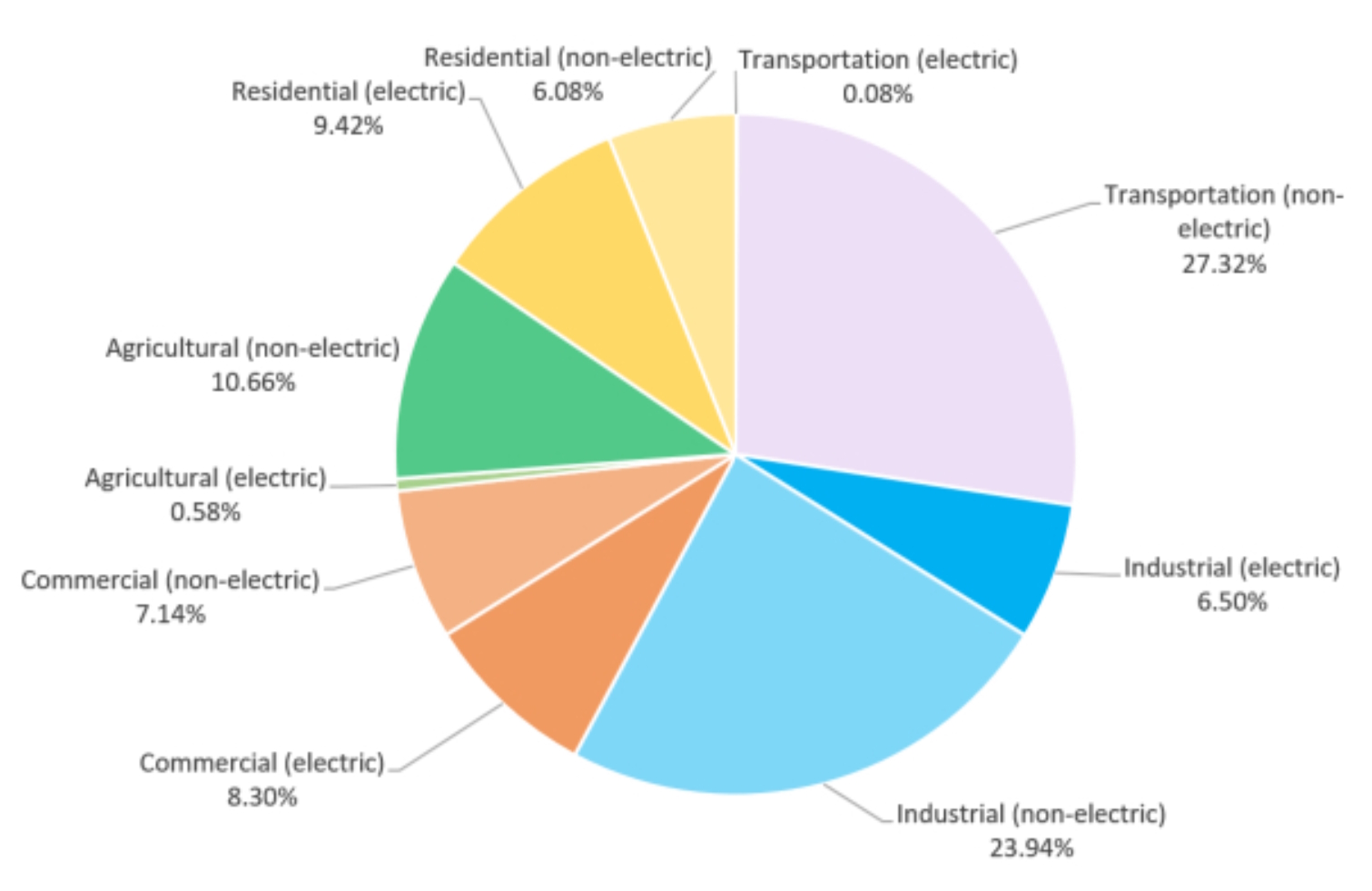
Electrification is in the early stages of deployment. Today, non-electric emissions dominate in most segments (Figure 1). This FAQ provides a broad and deep review of how AI and ML can support decarbonization. It begins with a layered view of how AI and digitization will be implemented across the utility grid, then reviews how AI will enable the use of phasor measurement units (PMUs) that support efficient integration of renewable energy into the transmission grid, and closes with a glance at how ML is being used to unwrap and filter the data from PMUs into actionable information.
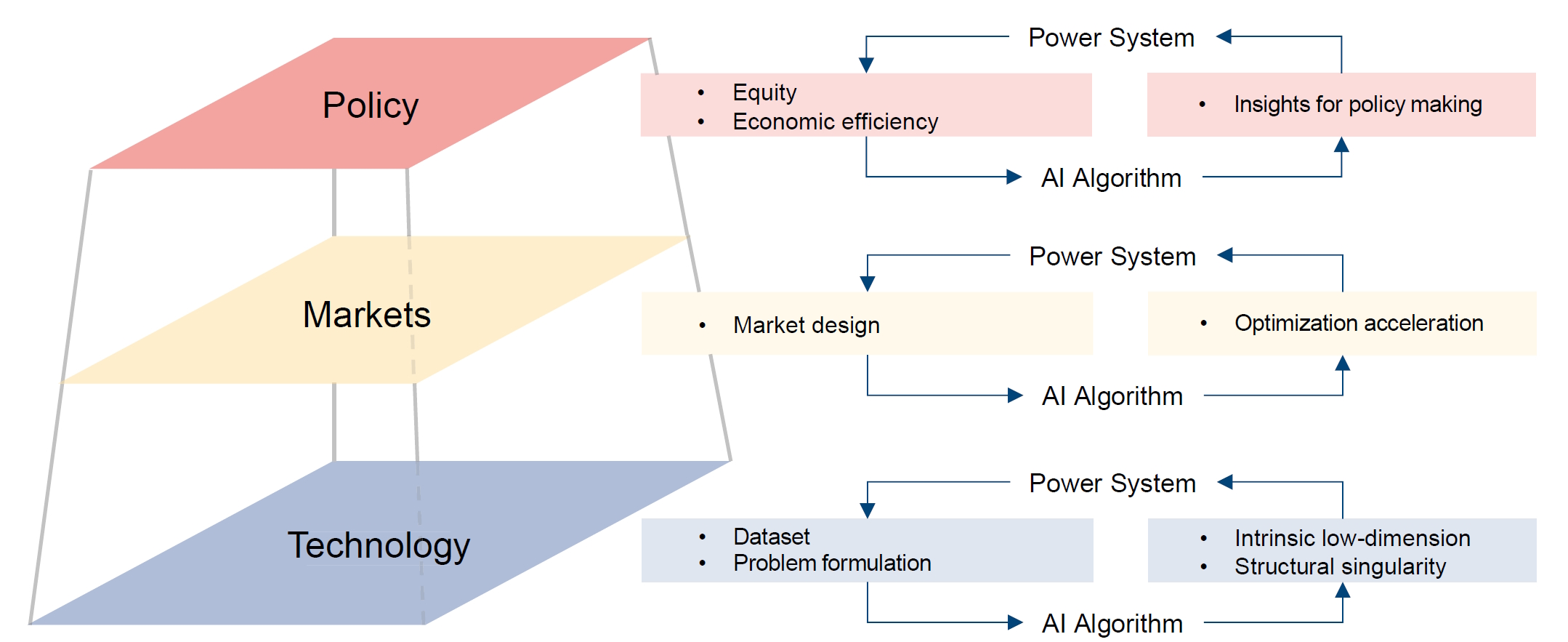
Integration of renewable energy sources into the utility grid is more than a technology problem. A layered vision of the factors involved in the decarbonization of the grid has been proposed that considers policy needs, market challenges, and technology demands.
Electric grids are heavily regulated. Development of policies that efficiently and equitably integrate renewables is expected to rely on AI to interpret the complex data sets available for renewable energy performance and costs, and how to best integrate them into the transmission and distribution grids.
AI and ML will also be needed to optimize performance at the market level. There will be new market participants, from residential PV to large-scale wind farms, that will have divergent interests and, in some cases, non-compatible economic interests. AI and ML will be used to implement scenario-based optimization analyses to identify hidden tradeoffs and move toward globally maximal solutions.
Finally, the development of optimal policies and market solutions demands highly efficient technological integration of renewables into the grid. Renewables behave differently from conventional generation sources, and their integration will rely on AI and ML to enable efficient, cost-effective, and reliable solutions (Figure 2).
Phasors and the transmission grid
Transmission grid operating conditions are monitored using phasor measurement units (PMUs) that measure the magnitude and phase angle of the AC voltage or current at a specific location. More advanced designs called synchro-phasers use global positioning system (GPS) signals to time synchronize the measurements across large areas of the grid. That enables the detection of anomalous conditions that can result from physical faults on the grids, electrical disturbances, or cyber-attacks. AI and ML tools have been developed and proposed for monitoring the integrity of transmission grids. Examples include:
- Long Short-Term Memory (LSTM) neural networks can save long-term temporal relationships and data patterns.
- Convolutional Long Short-Term Memory (C-LSTM) is a hybrid ML algorithm that combines two different architectures to produce a better analysis of temporal and spatial relationships in a data set.
- Bidirectional LSTM (Bi-LSTM) combines two LSTM layers, one operating as a forward-looking analysis and the second looking back at previous data. The combination can provide a better context for data analysis.
Unwrapping and filtering
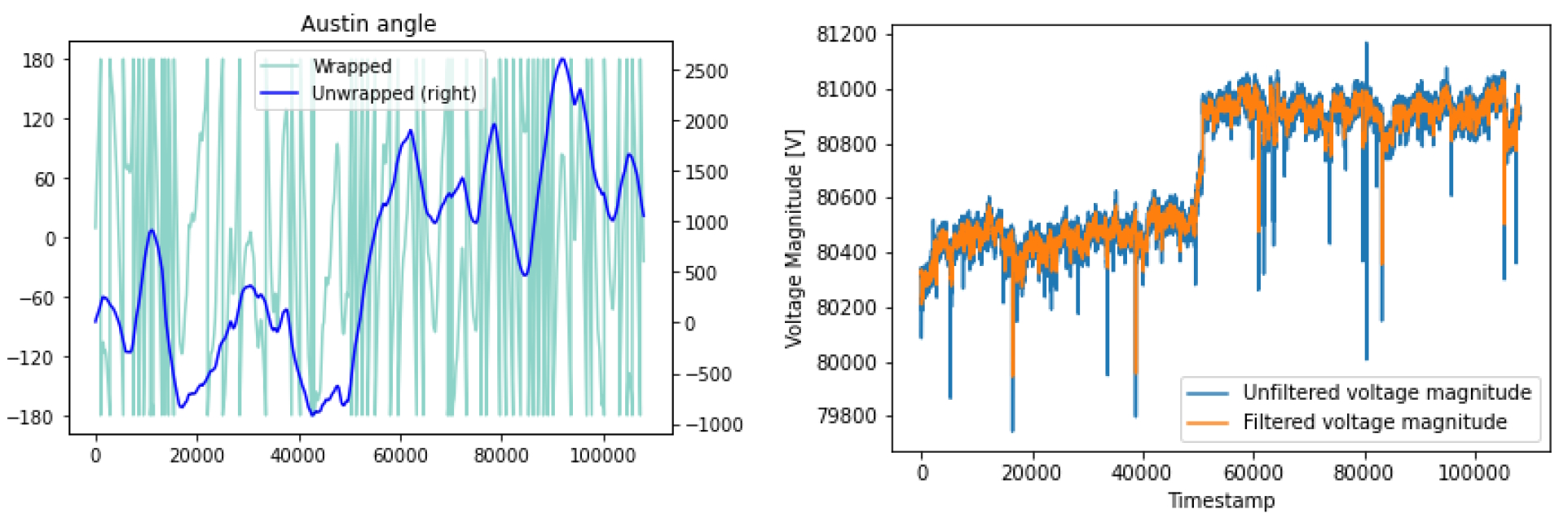
Synchrophasors in compliance with IEEE C37.118 report angles in terms of ±π radians. That’s ok if the system operates at a constant frequency, but on a real transmission grid, the frequency varies in a window around 60 Hz. That can cause the measured angles to drift, and they can jump as the frequency changes, resulting in crossing the ±π limit. This is called wrapping. Unwrapping involves the elimination of discontinuities caused by wrapping that don’t reflect any actual grid conditions.
In addition, there can be spikes in unfiltered phasor measurements that may be caused by load changes or other phenomena and don’t reflect any anomalous conditions on the grid itself. As a result, before phasor data can be used in AI or ML algorithms, it must be unwrapped and filtered (Figure 3). AI and ML can be used in the tools for unwrapping and filtering the data.
Summary
AI and ML provide powerful tools for the decarbonization of the utility grid. They can be used to improve policy development, market analysis, and implement the technical solutions needed for integrating renewals, like real-time monitoring of grid stability and identification of anomalies using synchronphasor measurements.
References
Driving a More Sustainable Future: Transforming Transportation and Energy to put us on a Path to Carbon Neutrality, Hitachi
Energy system digitization in the era of AI: A three-layered approach toward carbon neutrality, Science Direct
Harnessing the Power of Artificial Intelligence for Collaborative Energy Optimization Platforms, MDPI energies
Hybrid AI-based Anomaly Detection Model using Phasor Measurement Unit Data, arVix
Machine learning for a sustainable energy future, Nature Reviews Materials
Why AI and energy are the new power couple, International Energy Agency