
OpenClaw is being touted as the “operating system for personal AI.” It’s being supported by a wide array of companies, including NVIDIA. Target applications range from generative and agentic AI in consumer devices like smartphones, edge applications like medical devices, and physical AI (PAI) in robotics.
Formerly called Clawdbot, OpenClaw is designed to fill a performance gap between passive AI chatbots that generate text and agentic AI capable of executing complex scenarios across local computers and messaging apps. It’s free and open-source.
OpenClaw runs autonomously on local hardware and offers privacy controls over data and the application programming interface (API) access. It automates repetitive tasks like Gmail, Slack, WhatsApp, Telegram, and GitHub using pre-packaged scripts called “skills.” It’s designed for knowledgeable developers and users who can navigate the details of a local server or containerized installation and are skilled in handling a wide variety of security vulnerabilities.
It’s a TypeScript control line interface (CLI) application. It relies on Node.js (v22 or higher) to provide high portability across macOS, Linux, and Windows. It operates as a persistent process on the local machine managing a gateway server to coordinate channel connections, execute local tools, and communicate with large language model (LLM) APIs.
The pipeline architecture supports reliability and state management. Key elements include (Figure 1).
- Channel adapter that normalizes incoming messages and extracts attachments.
- The gateway server is called the “heart” and routes messages to the correct session and handles multiple overlapping requests.
- An agent runner that dynamically builds the system prompt by assembling tools, skills, and memory required, while the “context window guard” monitors token usage to compact or summarize sessions.
- LLM API interaction functions as the “brain,” providing the intelligence to understand user prompts, reason through tasks, and generate structured commands for tool execution.
- Agentic loop executes LMM-called tools locally and feeds the results back until a final response results.
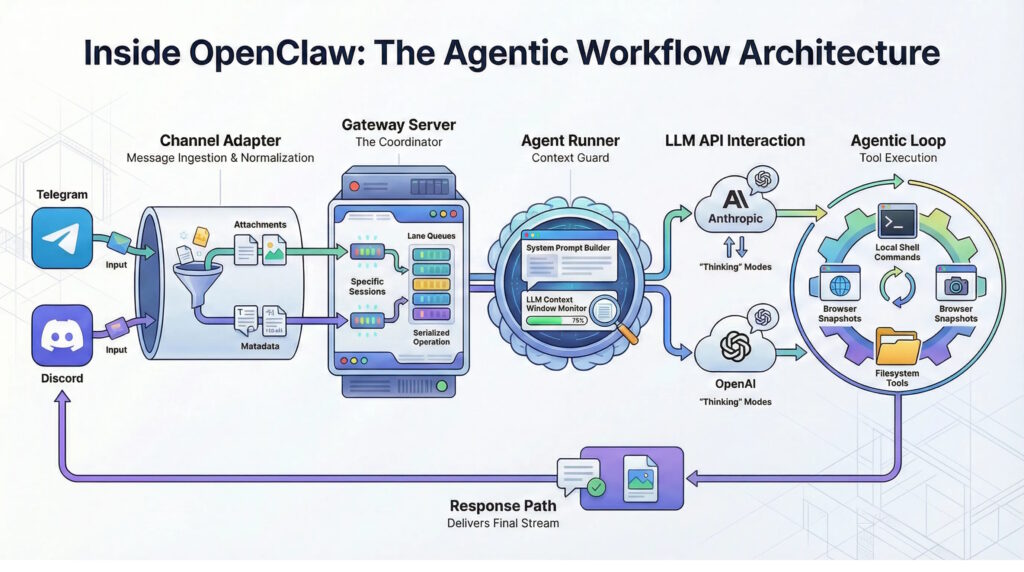
A key feature of OpenClaw is the so-called “lane strategy” that serializes operations. Instead of allowing concurrent uncoordinated execution. During a session, tasks run in turn, producing deterministic behavior. Implemented using src/process/command-queue.ts, and is designed to handle high-volume asynchronous messaging apps like Telegram and Discord.
AI-powered automation
OpenClaw is implemented as a long-running Node.js service that functions as an “operating system for AI agents,” not just a chatbot wrapper. Its layered architecture uses a central Gateway to route messages from various platforms to an Agent Runtime.
The modular structure provides an infrastructure layer that can transform AI models into autonomous “digital workers.” There are several key components that support AI-powered automation. It starts with defining AI agent personas and goals, then configuring task sequences, and monitoring the execution (Figure 2).
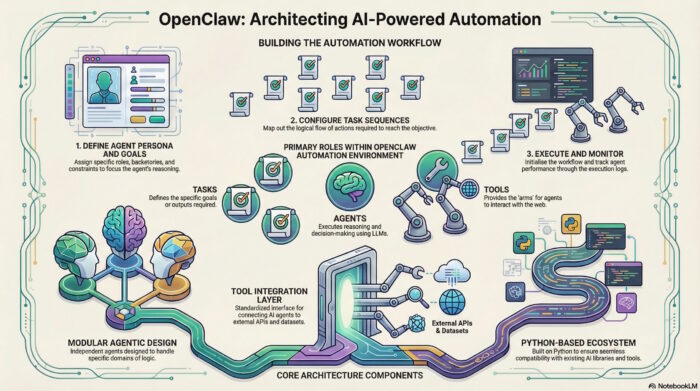
OpenClaw is an AI-native automation framework that uses event triggers, tool execution, retry logic, and structured logging to manage agentic workflows. It can be used to build production-grade AI automation. It shifts AI automation from a prompt-based structure to a governed, auditable environment.
PAI and OpenClaw
OpenClaw can be used as an AI agent with PAI in humanoids and other robots that translates natural language commands into robot actions. It acts as a high-level decision layer on top of the robot operating system (ROS) 2.0 or through hardware drivers, replacing hard-coded programs with autonomous, conversational operations.
When combined with ROS 2.0, OpenClaw can be used to provide a bridge between AI perception and physical execution. That can simplify advanced robotic operation. For example, users can say or text, “move forward one foot” instead of writing code.
Robots can also return images using messaging apps for remote confirmation of current position and orientation. That visual feedback can be used to accurately control gestures and object manipulation with humanoid hands and arms.
Summary
OpenClaw is an open-source, autonomous AI agent framework designed to automate complex, multi-step workflows. It’s a powerful, innovative tool that brings real-world action to AI, including PAI. It’s early in its development and still carries high security risks, making it more suitable for developers skilled in handling security vulnerabilities.
References
A Deep Dive Into The Epic Rise of OpenClaw, OAX Foundation
NVIDIA Announces NemoClaw for the OpenClaw Community, NVIDIA
OpenClaw, openclaw.ai
OpenClaw (Formerly Clawdbot & Moltbot) Explained, Milvus
OpenClaw and the Birth of AI Labor, Next Signal Predictdion
OpenClaw security: architecture and hardening guide, Nebius
OpenClaw Use Cases for Digital Marketing: 15 Proven Applications That Save 15–20 Hours Per Week, ALM Corp.
The Ultimate Guide to OpenClaw Supported Providers List 2026, Skywork
Unleashing OpenClaw: The Ultimate Guide to Local AI Agents for Developers in 2026, DEV Community
Unlocking the “Lobster Way”: A Technical Deep Dive into OpenClaw’s Architecture, Towards AWS
What Is OpenClaw and How to Build AI-Powered Automation Workflows, C# Corner
What is OpenClaw, and Why Should You Care?, Baker Botts
What is OpenClaw? Your Open-Source AI Assistant for 2026, Latenode
What Is OpenClaw? Why Developers Are Obsessed With This AI Agent, Clarifai
Related EEWorld Online content
How is power limiting the adoption of physical artificial intelligence in humanoid robotics?
How does the Zenoh protocol enhance edge device operation?
What specifications are needed for card edge connectors in AI/ML systems?
What is physical artificial intelligence and why is it important?
How is physical artificial intelligence used to optimize data center efficiency?