
At APEC 2026, EPC CEO Alex Lidow spoke with EEWorld Director Aimee Kalnoskas and Power Electronics Author Jeff Shepard for a conversation that goes far beyond GaN hype. From pioneering GaN adoption in AI server boards and scaling “apex” applications like humanoid robotics, to navigating fierce competition, IP battles, and shifting US innovation policy, Lidow lays out a candid, strategic view of where power electronics is headed, and what it takes to stay ahead.
EEWorld: You’ve been on AI server boards for eight years, well ahead of the market. What was the thinking behind that, and how does it connect to your broader strategy?
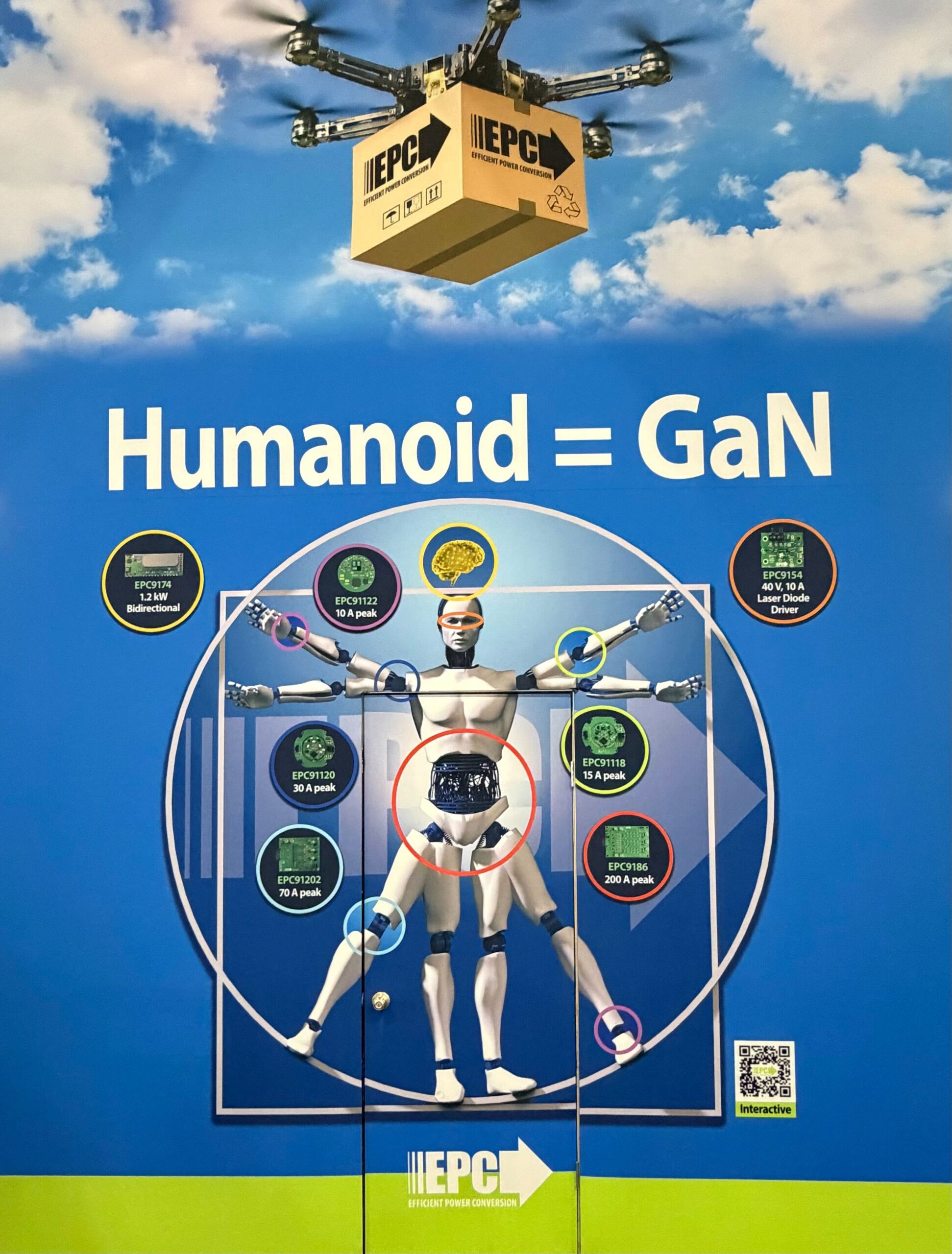
Lidow: I call it an “apex” application: solve the hardest problem first, and all the other problems follow. The technology works everywhere once you’ve proven it at the top. I’m not trying to ride a wave. I’m trying to build a foundation that works for many years.
The second apex application is humanoid robots. We have 300 parts in some very high-profile robots, primarily in motor control, but also LIDAR and chargers. There are 40 motors in these robots. We’ve got a 15-amp RMS drive designed for shoulder joints that also works for drones. A 50-amp version handles larger joints, and an 80-amp version goes even further. The same architecture scales across e-bikes, power tools, and drones. Once you identify these apex applications, they pay a premium because they have to have it. Then you get the volume from everything else that follows, and the cost comes down.
EEWorld: You mentioned seventh-generation GaN and breaking into new voltage ranges. What are the two main technical fronts you’re pushing on, and where is the biggest design-in opportunity right now?
Lidow: Two fronts: motor drives and high-density power conversion. Our seventh-generation GaN was the first to break open the very low-voltage markets. From 350 volts all the way down to zero, our performance is significantly better than any MOSFET in the world. Lower voltage means bigger markets and, counterintuitively, customers who are willing to pay a premium for performance. We’re seeing a huge wave of server card design activity across 48-to-12, 48-to-8, and 8-to-0 conversions, all moving toward GaN. We’re the only ones doing that across that full range. That will be the biggest design-in movement for GaN ever, as long as we stay ahead. Data centers are currently a quarter of our revenue. Space is another quarter.
EEWorld: Large IDMs have their own fabs, deep pockets, and broad product lines spanning multiple technologies. How do you think about that competitive threat, and what keeps EPC ahead?
Lidow: Large IDMs own their fabs and they’ll try to fill them. I’ve watched this movie before. When the power MOSFET emerged in the late 1970s, the dominant bipolar transistor makers went through every stage of denial: dismissing the new technology, claiming they could do it better when they were ready, then telling customers they could trust them because they offered both. By the time they were fully committed, the gap was too large. Today’s large competitors are better companies than those predecessors, but the transition will still be painful for them. We stay ahead by being two generations in front on the technology treadmill. As long as we can do something they can’t yet do, we keep the premium.
EEWorld: You’ve been through the ITC, patent challenges, and Customs enforcement issues. Can you walk us through how the IP protection landscape has shifted and what it means for small innovators?
Lidow: The US is now the worst place in the developed world for protecting intellectual property. Injunctions were effectively removed after a key Supreme Court decision. The Patent Trial and Appeal Board is being weaponized by large companies filing unlimited IPR challenges at roughly $2 million each. Even if you win, they can file again the following week. We spent $18 million going through the ITC, won a successful resolution, and then Customs let infringing product through anyway because the other party simply claimed they had designed around our patents, with zero discovery or verification. Nobody at Customs has the technical background to evaluate that claim.
With our earlier MOSFET patents, we had 25 licensees, eight successful court cases, and 18 successful appeals. The injunction was the lever that led to settlements. That tool no longer exists. I’ve been to Washington multiple times recently, talking to Senate subcommittees on China competition, Homeland Security, and IP protection. It’s a slow and frustrating process, but somebody has to work those angles.
EEWorld: With all of those legal and competitive pressures pulling at your attention, how do you keep the engineering organization focused on what matters?
Lidow: Build a better product. Head down. Build a better product.