
Artificial intelligence crossed a critical threshold in 2026. AI is no longer confined to research labs or narrow pilot programs. It sits at the strategic core of nearly every major industry, with global AI spending projected to exceed $2 trillion in 2026 alone. That is a 36% year-over-year increase. Enterprise adoption has reached 88%, though ROI remains a challenge for many. In 2025 alone, AI companies captured 48% of all equity funding despite these representing just 23% of total deals. Over 90% of Fortune 500 companies are actively deploying AI systems. There are currently 3.2 open AI job positions for every qualified professional who can fill them. There’s a wide skill gap that is not going to close anytime soon. So, anyone with a solid engineering foundation who understands systems, data, and math has genuinely one of the best possible moments to pivot into an AI specialization.
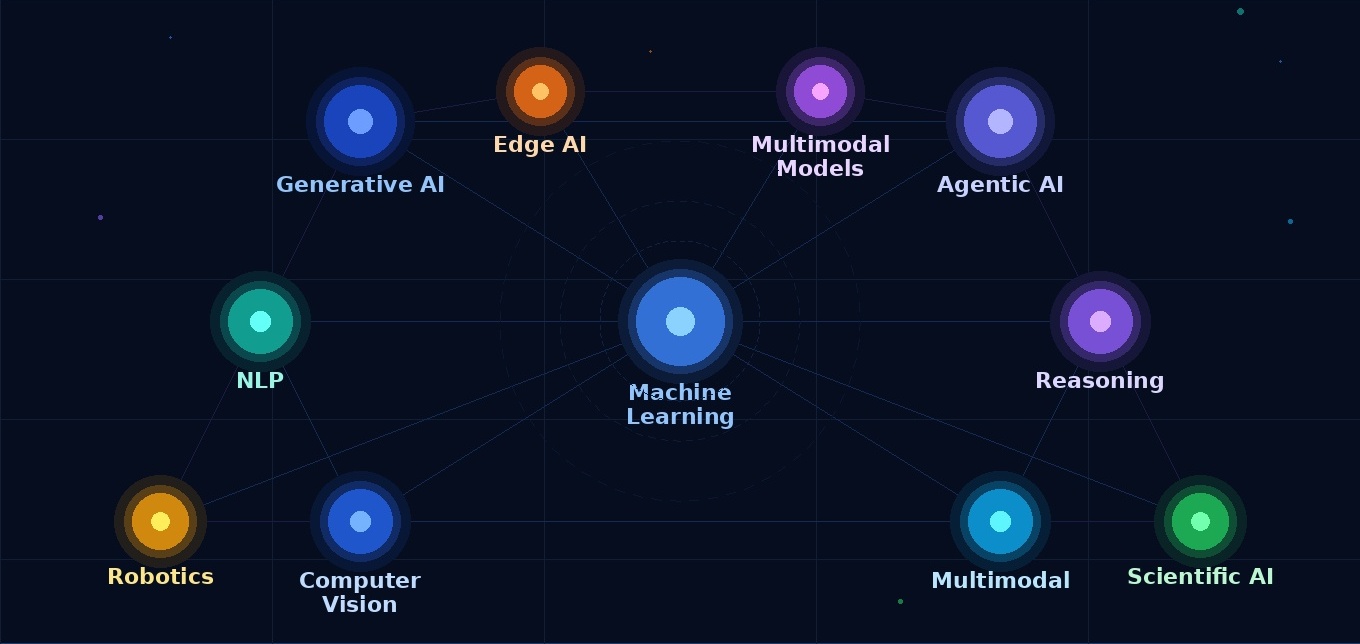 In 2026, the AI landscape has bifurcated into Foundation (Generative, Multimodal) and Action (Agentic, Robotics, Scientific) layers. While 2024 was about “chatting,” 2026 is about “doing.” AI is really a vast field. There is Agentic AI, Deep Reasoning, Generative AI, Scientific AI, Edge AI, Physical AI (Robotics), Computer Vision, Natural Language Processing, and a dozen other areas. Whether you are a business leader assessing where to invest, a developer choosing a specialization, or a researcher tracking the frontiers of capability, it is important for you to know where AI stands today and where it is heading. In this article, we’ll walk you through the top AI domains that matter most in 2026 – what each one is, why it matters, what tools professionals in that domain actually use day to day, what companies are hiring, and what a career path looks like.
Machine learning
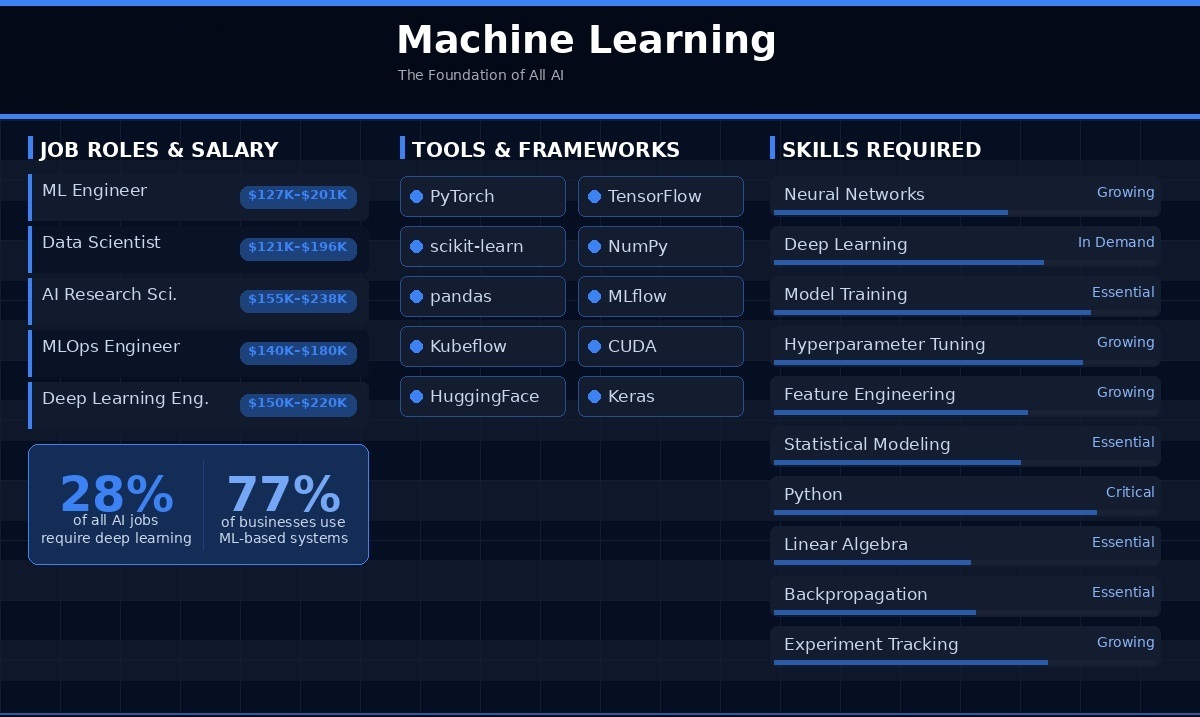 If AI were a house, machine learning would be the foundation. Every other domain, whether it’s computer vision, natural language processing, or robotics, has machine learning sitting underneath it. So even if you end up specializing somewhere else, you need to understand this first.
Machine learning is the practice of training algorithms to improve their performance at a task by exposing them to data, rather than by explicitly programming rules. Instead of writing: “if the email contains the word ‘urgent’ and was sent after 9 pm, flag it as important” — you feed a model thousands of examples of emails that humans rated as important, and the model figures out the patterns itself. The deep learning subset of ML — where you stack many layers of artificial neurons — is what drove the last decade of AI breakthroughs. It’s what powers image recognition, voice assistants, and the large language models you’ve almost certainly used yourself.
The ML market accounts for roughly 37% of all AI technology spending, is sitting at around $134 billion in 2026, and is expected to grow to $420 billion by 2030. The global AI market, which includes machine learning, was valued at $294 billion in 2025 and is expected to reach $376 billion in 2026, with a compound annual growth rate of 26.6% through 2034. Every product you’ll ever work on in AI will use ML somewhere. In 2026, the focus has shifted toward “Small Data” learning—the ability to fine-tune models on proprietary enterprise data with minimal risk of “catastrophic forgetting.” Recently launched NVIDIA’s Blackwell Ultra B300 GPU in January 2026 delivers 50% more inference throughput than its predecessor. Hardware keeps improving, which means models that were too expensive to run two years ago are now entirely practical.
For machine learning, Python is non-negotiable. It’s the language of ML, full stop. From there, the core frameworks are TensorFlow (developed by Google) and PyTorch (developed by Meta). PyTorch has become dominant in research because it’s more flexible and easier to debug. You use NumPy and pandas for data manipulation, scikit-learn for classical algorithms, and Hugging Face’s Transformers library to work with pre-trained models.
Once you’re building things that need to run reliably in production, you’ll meet the world of MLOps — tools like MLflow for experiment tracking, Weights & Biases for visualizing training runs, and Kubernetes for deploying models at scale. Kubernetes shows up in nearly 18% of ML engineering job listings, which tells you that knowing how to ship a model to production is at least as valuable as knowing how to train one.
The career paths in machine learning include ML engineer, data scientist, and AI research scientist. Top hiring companies include Google, Microsoft, Amazon, Meta, NVIDIA, OpenAI, and Anthropic. The salaries for machine learning jobs range from $127,000 to $238,000 per year.
Natural language processing
 If you’ve used any chatbot like ChatGPT, Claude, Gemini, or any AI writing tool, you’ve used NLP. Natural language processing is the branch of AI that deals with how machines understand, generate, and interact using human language. It’s also the single largest commercial AI category in 2026, accounting for over 42% of generative AI revenues. For decades, NLP involved complicated hand-crafted rule systems and statistical models that were brittle and narrow. Then, in 2017, Google researchers published a paper called ‘Attention Is All You Need’ and introduced the Transformer architecture. Within a few years, transformer-based models completely transformed the field. Today’s large language models — GPT-5.4, Claude, Gemini — are all built on variations of this architecture. There are now models that can summarize legal contracts, write production-quality code, translate between languages in real-time, answer questions from internal company documents, and carry on coherent multi-turn conversations. NLP has a $42 billion market in 2026.
While working on NLP, you will spend a lot of time working with Hugging Face’s ecosystem — specifically the Transformers library, which gives you access to thousands of pre-trained models you can fine-tune for specific tasks. LangChain is essentially the plumbing framework for building LLM-powered applications: it handles things like managing conversation history, connecting models to external tools, and orchestrating multi-step pipelines. It has over 126,000 GitHub stars for a reason. Then there are Vector databases — Pinecone, Chroma, Weaviate that have become essential for retrieval-augmented generation (RAG), the technique of feeding relevant documents into a model’s context before asking it a question. If you’re building anything where the AI needs to know about your company’s specific data, you’ll use RAG. And if you want to specialize in an existing model for a specific task without training from scratch, you’ll learn LoRA (Low-Rank Adaptation), which has become the dominant fine-tuning technique because it’s efficient enough to run on consumer hardware.
The key job roles in NLP are NLP Engineer, LLM Fine-Tuning Specialist, and Prompt Engineer/AI System Designer, with hiring in sectors like healthcare, finance, legal, customer experience, and SaaS. Major companies involved are OpenAI, Anthropic, Google, Microsoft, Cohere, Hugging Face, and AI21 Labs. The job role of ‘Prompt Engineer’ is nowadays evolving into ‘AI Systems Designer’ as the work becomes more sophisticated. This involves building well-designed prompting pipelines, evaluation frameworks, and robust model integration architectures, which is genuinely skilled engineering work. The salaries range from $127,000 to $160,000 per year.
Computer vision
 Computer vision is all about AI systems that can see and understand images and video. Your phone unlocks when it recognizes your face. A factory robot spots defective parts on a conveyor belt. A radiologist’s workstation flags suspicious lung nodules on a CT scan before the doctor even opens the file. That’s all computer vision. The computer vision market sits at around $22 billion in 2026, with North America holding the biggest share. The domain has been transformed by the shift from hand-crafted feature extraction (where engineers manually described what to look for) to deep learning (where CNNs — Convolutional Neural Networks — learn visual features automatically from data). More recently, Vision Transformers (ViTs) have challenged CNNs in high-accuracy tasks and are increasingly common.
Recently, at GTC 2026, NVIDIA launched the Isaac GR00T robotics model. It is an important milestone as a framework specifically built for high-fidelity 3D visual perception in industrial robotics, integrating depth sensing, object recognition, and spatial reasoning. Autonomous driving is another massive application — Waymo now operates commercially in five US cities, and Helm.ai launched Vision in June 2025, a production-grade urban perception system for Level 2+ driving. Both represent years of computer vision engineering applied at scale.
The key tools you need to learn for working on computer vision are OpenCV, PyTorch, Open3D, and PyTorch3D. OpenCV is the foundational library — it handles image loading, transformation, and classical processing. PyTorch Vision (torchvision) is used for model training and modern architectures. For object detection, YOLO (You Only Look Once) remains widely used in production due to its speed. Newer transformer-based detectors like DETR are used when accuracy matters more than latency. For 3D vision, PyTorch3D and Open3D handle point cloud processing. NVIDIA’s CUDA-accelerated tools are essential when you need real-time performance.
The career path in the computer vision field is a Computer Vision Engineer, where you may start as a Junior CV Engineer and go up to CV Lead or Head of Perception. The average salary of a CV Engineer is $168,000 per year. Senior specialists get up to $312,000 per year. Top employers include NVIDIA, Google, Waymo, Tesla, Mobileye, Microsoft, and medical AI startups.
Robotics and physical AI
 This is probably the domain that most obviously resembles the science fiction conception of AI — machines that perceive, decide, and act in the physical world. And in 2026, it’s no longer science fiction. The AI-in-robotics market reached $20.4 billion in 2025 and is growing at 32% per year. Amazon deployed its millionth warehouse robot in 2026, coordinated by a system called DeepFleet AI that improved warehouse efficiency by 10%. BMW now operates factories where vehicles autonomously navigate production routes. Pony.ai launched over 100 seventh-generation robotaxis commercially in Guangzhou in March 2026. The International Federation of Robotics reported that industrial robot installations hit an all-time high market value of $16.7 billion in early 2026. Reasons are many, like labor shortages, rising wages, and AI-native control systems that are finally capable enough to handle the messy, unpredictable reality of physical environments.
While Software AI deals in tokens, pixels, and probabilities, Physical AI has to deal with gravity, friction, sensor noise, and the infinite variability of the real world. A robot arm needs to pick up any arbitrary object from a pile in a warehouse, handling different shapes, weights, and surface textures. This requires solving computer vision, motion planning, force control, and real-time decision-making simultaneously. That’s an extremely hard problem. It’s also why people who can solve it are extremely well-compensated.
If you want to start a career in Physical AI and Robotics, ROS 2 is your primary tool. ROS 2 (Robot Operating System 2) is the industry standard for robotics software development. It provides the communication infrastructure, sensor drivers, and simulation interfaces that most commercial robotics systems are built on. NVIDIA’s Isaac Sim provides a physics-accurate simulation environment for training and testing robot behaviors before deploying them on hardware. PyTorch and TensorFlow are used for training reinforcement learning policies. SLAM (Simultaneous Localization and Mapping) algorithms handle navigation in unknown environments.
You can build a career as a Robotics Software Engineer with key roles like Perception Engineer, Motion Planning Engineer, or Simulation Engineer. Boston Dynamics, Figure AI, 1X Technologies, Tesla, and Amazon Robotics are the top companies. The salary of a Robotics Software Engineer varies from $130,000 to $200,000 per year. You need proficiency in C++ and Python, with your hands getting dirty on ROS2 and some personal robotics projects.
Agentic AI
 Once most underestimated, Agentic AI is an AI field that is causing the most disruption to how businesses actually operate in 2026. Agentic AI refers to AI systems that can take sequences of actions — using tools, calling APIs, writing and executing code, browsing the web — to accomplish complex goals with minimal human oversight. The difference between a chatbot and an agent is the difference between someone who gives you advice and someone who actually executes the task. If you ask a chatbot how to analyze sales data, it tells you how. An agent opens your spreadsheet, writes the analysis code, runs it, interprets the results, and sends a summary to your team’s Slack channel.
Gartner predicts that 40% of all enterprise applications will incorporate task-specific AI agents by the end of 2026 — up from less than 5% just a year earlier. Multi-agent workflow adoption grew 327% between June and October 2025 alone. Over 80% of Fortune 500 companies have already deployed AI agents using low-code tools. A Snowflake-OpenAI $200 million partnership specifically targets autonomous enterprise data agents.
For developing and deploying AI agents, multiple tools are used. LangChain is the most widely used foundation — it handles tool integration, memory management, and agent orchestration. LangGraph, built on top of LangChain, provides graph-based stateful orchestration for complex multi-agent systems where you need precise control and full audit trails — important for enterprise production deployments. CrewAI takes a different approach: you define agents as team members with specific roles and let them collaborate — it’s the fastest path from prototype to production and is reportedly used by over 60% of Fortune 500 companies experimenting with agents.
For Microsoft Azure shops, AutoGen (now part of the Microsoft Agent Framework) is the natural choice. Google’s ADK (Agent Development Kit) handles cloud-native agent deployment. And the Model Context Protocol (MCP), originally created by Anthropic and donated to the Linux Foundation in 2026, has become the universal standard for connecting AI agents to external tools, APIs, and data sources — it’s supported by over 150 organizations. If you’re building enterprise agents, you will encounter MCP.
Virtually every enterprise software company, including Anthropic, OpenAI, Microsoft, Salesforce, etc., is hiring AI Agent Engineers or AI Automation Engineers. Their salaries range from $110,000 to $160,000 per year. The role is actually evolving from ‘prompt engineering’ toward ‘agent systems design’. Key skills required are Python, LangChain/LangGraph, MCP, tool integration, prompt design, and eval frameworks.
Reasoning models

In 2026, Reasoning Models are becoming the sophisticated “engine” that powers the chatbot interface. In 2026, enterprises and consumers view the “chat” interface as a universal front end that can dynamically trigger different “modes” based on the task. While Reasoning Models are the back-end logical engine built with architectures — like reinforcement learning and “chain-of-thought” processing — that force the model to “stop and think” before generating an answer. In the modern AI landscape, Chatbots and Reasoning Models complement each other within a hybrid agent. Reasoning models are the “brain” that finally makes the “chatbot” reliable, accurate, and useful enough for real-world professional work. Most of the standard chatbots like GPT-5, Gemini Flash, Claude 4.5 Sonnet, and Llama 4 (Standard) are now multimodal, hybrid-architecture systems that feature internal reasoning controls. Some standalone Reasoning Models are OpenAI o1 / o4 series, Google Gemini 3 “Deep Think”, DeepSeek-R1, and Claude 4.5 “Extended Thinking” Mode.
While standard language models generate the next token based on what came before, Reasoning models allocate dedicated ‘thinking time’ — generating a chain of intermediate steps before producing a final answer. The result is dramatically better performance on complex tasks such as math problems, logical reasoning, multi-step code generation, and strategic planning. Software engineering benchmark scores jumped from around 60% in 2024 to near-perfect within a year, largely due to reasoning improvements.
This year is instead witnessing a benchmark race. Google’s Gemini 3.1 Pro, released in February 2026, currently leads the reasoning benchmarks that matter most to researchers: 94.3% on GPQA (a test of graduate-level scientific reasoning) and 77.1% on ARC-AGI-2 — more than double Gemini 3 Pro’s score from the prior year, which is a staggering rate of improvement within a single model family. OpenAI’s GPT-5.4 scored 83% on GDPVal, a benchmark measuring whether AI can perform at a human expert level across professional occupations.
Perhaps the most interesting development is DeepSeek V4, released in early March 2026. At 1 trillion parameters running on Huawei chips, it achieves roughly 90% of GPT-5.4’s reasoning performance — at $0.28 per million input tokens versus $2.50 for GPT-5.4. That 50x cost gap makes frontier-quality reasoning accessible to startups and small teams who couldn’t previously afford it. Cost efficiency is now a genuine competitive variable in model selection.
Working with reasoning models requires understanding how to structure prompts for chain-of-thought reasoning, how to evaluate reasoning quality (not just final answer accuracy), and how to build systems that use extended reasoning selectively — since reasoning mode costs more compute than standard generation. Familiarity with evaluation benchmarks (GPQA, ARC-AGI, SWE-bench) helps you assess models objectively rather than relying on marketing.
AI Research Scientist (reasoning) and Applied AI Engineer (reasoning deployment) are two main career paths in this field. AI Research Scientist (reasoning) is paid $155,000 to $238,000 per year, and even significantly more at frontier labs with equity. The Applied AI Engineer (reasoning deployment) position pays between $140,000 and $200,000 per year. The Research path typically requires a strong ML background with a preference for a PhD and publications at NeurIPS/ICML/ICLR. The applied path requires Python, API fluency, evaluation engineering, and prompt architecture skills.
Generative AI

Generative AI refers to systems that create text, images, code, audio, and video rather than just analyzing data. The practical applications driving revenue are less glamorous than the demos but more important to understand, like code generation (GitHub Copilot, Cursor), document automation (contract drafting, report generation), customer service (AI agents handling tier-1 support), marketing content (ad copy, product descriptions, email personalization), and developer tooling.
These are not experimental — they’re running in production at large enterprises right now. The market reached $83 billion in 2026 and is growing at 31.6% per year. Enterprise spending on GenAI hit $37 billion in 2025, which was a 3.2x increase from the year before. Cursor, the AI-native code editor, hit $2 billion in annual recurring revenue in 2026. Claude Code, Anthropic’s command-line coding agent, is used by engineering teams to handle entire features end-to-end. GitHub Copilot’s data shows AI coding tools save engineers 8 to 12 hours per week. These numbers help explain why 92% of Fortune 500 companies are now active OpenAI users.
If you’re building GenAI applications, you’ll work primarily through APIs — OpenAI’s, Anthropic’s, or Google’s — combined with orchestration frameworks like LangChain or LlamaIndex. For image generation in professional contexts, Adobe Firefly is increasingly used by enterprise teams because it’s trained on licensed content, avoiding intellectual property complications. For voice, ElevenLabs has become the standard for high-quality speech synthesis. For media production use cases, Runway ML and Kling serve video generation.
Evaluation is where a lot of GenAI systems fail in production. Building evals, the systematic tests that check model outputs for accuracy, safety, and task completion, is one of the most underrated engineering skills in this domain. Tools like LangSmith and Weights & Biases help, but the craft of designing good evals is genuinely hard and highly valued.
The key positions include GenAI Application Developer ($130,000 ~ $190,000 per year), AI Product Manager ($180,000 ~ $250,000+ per year), AI Business Development Manager ($196,491 per year on average), Evaluation engineer / red-teamer ($140,000 ~ $200,000 per year), and Creative AI Specialist ($90,000 ~ $150,000 per year). The creative AI Specialists are now aggressively hired by design, marketing, and media companies.
Multimodal AI

For most of AI’s history, models were siloed by data type — there were image models, language models, and audio models. Multimodal AI tears down those silos. A multimodal model can look at an X-ray, read the accompanying patient notes, listen to a doctor’s voice recording of observations, and synthesize all three into a coherent diagnostic summary.
Every major frontier model released in 2026 ships with multimodal capability by default. Meta’s Llama 4 Scout processes up to 10 million tokens — enough to fit an entire feature film plus documentation plus research papers in a single context window — with native multimodality across text, images, and audio. Google’s Gemini 3.1 Pro leads multimodal reasoning benchmarks. GPT-5.4 includes built-in computer use, meaning it can look at a screen, understand what it sees, and interact with software directly. The conceptual shift worth understanding is that 2026’s multimodal models aren’t just ‘processing different types.’ They’re doing cross-modal reasoning — synthesizing understanding across modalities the way a human expert does when diagnosing a patient or debugging a complex system. That makes them qualitatively more capable for real-world applications.
Understanding multimodal systems requires knowing how different modalities are encoded into a shared representation space. Vision transformers (ViTs) handle image encoding. CLIP (Contrastive Language-Image Pre-training) and its successors handle vision-language alignment. Cross-attention mechanisms allow information from one modality to influence processing in another. For practitioners, the main frameworks are the same as NLP — Hugging Face Transformers, PyTorch — but you’ll additionally work with vision libraries and understand tokenization schemes for non-text inputs.
The Key job role in this field is Multimodal AI Engineer. These engineers are paid between $150,000 and $250,000+ per year. One needs to specialize in one modality first, then expand cross-modally. The key skills required for this position are PyTorch Vision, Transformers, and cross-modal data curation. Most of the hiring is coming from areas like healthcare AI diagnostics, industrial inspection, and retail visual search. There are also research opportunities at Google DeepMind, OpenAI, Meta FAIR, and Anthropic.
Scientific AI

This domain is where AI’s potential impact feels truly extraordinary. Scientific AI applies machine learning to the hardest problems in human knowledge: how do proteins fold? How will climate change affect specific regions over the next 50 years? What combination of molecules might defeat a drug-resistant pathogen? These are questions that took decades of human research — and AI is beginning to accelerate the process dramatically.
Google DeepMind’s AlphaFold 3 expanded beyond protein structure prediction to model how proteins interact with DNA, RNA, and small molecules — including potential drug candidates. This single system has accelerated research across hundreds of pharmaceutical programs. Anthropic acquired a company called Coefficient Bio in April 2026, establishing a direct presence in AI-driven drug discovery. OpenAI created a dedicated AI for Science team. The largest AI labs are clearly betting on this domain.
Clinical applications are progressing in parallel. Researchers at the University of Michigan developed an AI system that diagnoses coronary microvascular dysfunction from a standard 10-second EKG — a condition that previously required invasive testing or advanced imaging. IBM has committed to demonstrating quantum-AI hybrid computing advantages in drug development and materials science by the end of 2026. Pure-play AI drug discovery companies like Recursion Pharmaceuticals, Insilico Medicine, and AbSci have active clinical-stage pipelines.
Scientific AI is one of the few domains where domain expertise genuinely matters as much as ML skills. A computational biologist who learns ML is as well-positioned as an ML engineer who learns biology. The tools include AlphaFold (protein structure), ESMFold (Meta’s protein language model), molecular generation frameworks like REINVENT, and domain-specific foundation models like BioGPT and PubMedBERT for biomedical text. Federated learning, which is training on distributed sensitive data without centralizing it, is essential for healthcare compliance.
The domain offers job positions like Computational Biologist / AI Drug Discovery Scientist, Clinical AI Specialist, and AI Research Scientist. AI Drug Discovery Scientists and Clinical AI Specialists are paid between $140,000 and $220,000 per year. An AI Research Scientist position pays between $200,000 and $300,000+ per year. One needs a PhD in biology, chemistry, or biomedical engineering with ML skills for entry-level positions, while cross-disciplinary master’s programs in computational biology may be required for growth prospects.
Edge AI
Edge AI refers to the deployment of artificial intelligence algorithms and models directly on local devices or gateways near the data source, rather than relying on a centralized cloud server to process every request. Suppose you’re designing a factory quality control system. A camera on the production line needs to inspect 500 parts per minute and flag defects in real time. You could send every image to a cloud server for analysis — but the round-trip latency alone would make the system too slow, and the data costs would be high. Or you could run a smaller, optimized AI model directly on a chip next to the camera, with sub-millisecond inference. That’s edge AI.
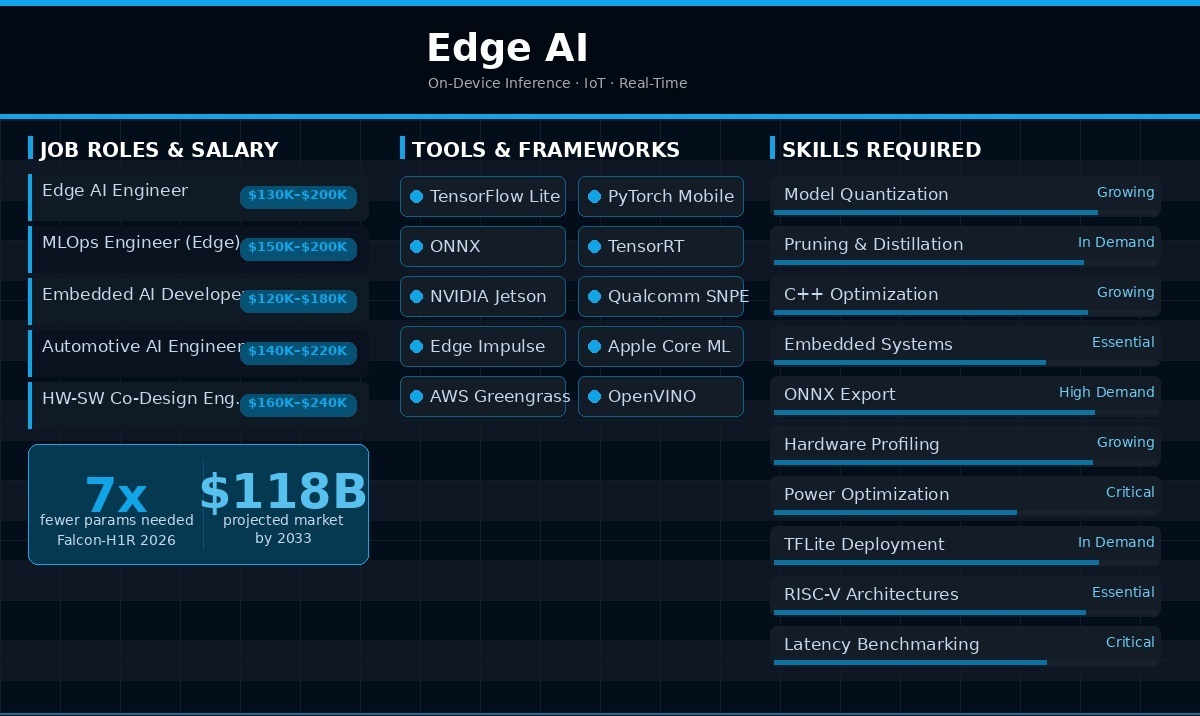
The industry is moving from ‘make models bigger’ to ‘make them smarter per parameter.’ The January 2026 launch of Falcon-H1R 7B — a Transformer-Mamba hybrid model that achieves elite performance with 7 times fewer parameters than comparably capable models — was a concrete demonstration of this shift. The edge AI market is $24.9 billion in 2026 and growing at 21.7% annually, projected to reach $118.7 billion by 2033. The manufacturing segment alone is growing at 23% CAGR — driven by quality inspection, predictive maintenance, and autonomous material handling systems that can’t afford cloud latency. Apple Silicon, Qualcomm’s Snapdragon AI platform, and NVIDIA’s edge accelerators are the dominant hardware platforms.
The core techniques used are model compression: quantization (reducing the numerical precision of model weights from 32-bit floats to 8-bit or 4-bit integers, often with minimal accuracy loss), pruning (removing weights that contribute little to performance), and knowledge distillation (training a small model to mimic a larger one). TensorFlow Lite and PyTorch Mobile handle on-device deployment. ONNX provides model portability across hardware. TensorRT from NVIDIA accelerates inference on NVIDIA edge hardware. A ‘three-tier hybrid’ architecture has emerged as the enterprise standard: cloud for elastic, heavy workloads and training; on-premises servers for data sovereignty and consistent performance; and edge devices for real-time, latency-sensitive inference. Designing systems that work intelligently across all three tiers is a sophisticated engineering challenge.
The key job positions in this field are Edge AI Engineer, MLOps Engineer (edge deployment), and Automotive AI Engineer (ADAS/perception). These positions pay between $130,000 and $200,000. The skills required for these positions are C++ and Python, model compression techniques, embedded systems, and TensorRT/TFLite. Hardware-software co-design expertise commands the highest premiums in this domain.
Conclusion
AI is now everywhere. It is really vast and spans across multiple domains, each requiring a different skill set and job perspective. If you are new to AI, the very first thing you need to do is learn Python. Learn NumPy, pandas, and PyTorch. Understand what a neural network is doing at a mathematical level, not just how to call the API. Learning Python alone could take 2 to 3 months. With a strong foundation in Python, pick one domain that genuinely interests you, not just the highest-paying one, because you’ll outperform in a domain you care about. The following table might help you.
 Go deep. Read the key papers, build projects that use the main tools, contribute to relevant open-source repositories, and engage with the community on Discord, GitHub, and Hugging Face. For most domains, building three strong projects is more valuable than ten shallow ones. The AI field moves fast enough that what was cutting-edge six months ago may already be table stakes. So, subscribe to relevant newsletters, follow key researchers and practitioners on X/Twitter, and read the original papers that matter and not just summaries. Understanding why something works, not just that it works, is what distinguishes engineers who grow from engineers who plateau.
The global AI talent demand-to-supply ratio stands at 3.2:1 in 2026. Professionals with AI specializations earn 43% more on average than peers without them, according to Oxford Internet Institute research. Ninety-five percent of organizations now factor basic AI skills into hiring decisions.
It takes 6 to 9 months to learn AI for a specific domain. Even if the AI path may not be easy, it’s worth it. If you have an engineering foundation and you understand systems, mathematics, and abstraction, AI is for you. The domain knowledge on top of that is learnable.