
There’s a critical symbiosis between artificial intelligence (AI) and solid-state transformers (SSTs), especially in hyperscale data centers, green energy systems, and electric vehicle (EV) infrastructure. Those applications increasingly rely on SSTs to maximize efficiency, and SSTs use AI to monitor, manage, and optimize complex grid dynamics and power conversion.
Individual AI computing clusters in hyperscale AI data centers can consume a megawatt (MW) of power. That requires a new approach to power distribution. Traditional AC-based power infrastructure is being replaced with 800 Vdc that can be delivered using a conventional medium-voltage rectifier or an SST (Figure 1).
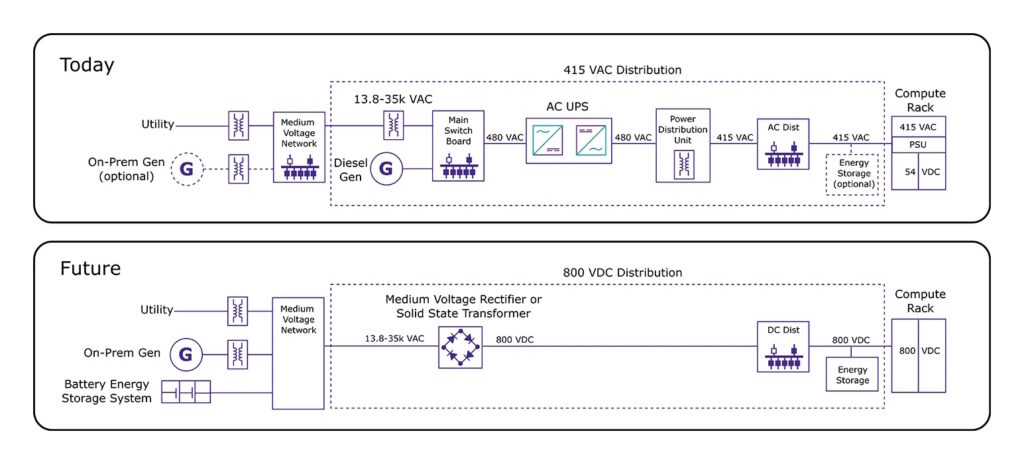
The 800 Vdc architecture delivers up to 5% better power distribution efficiency and 50% lower maintenance costs. The power conversion efficiency can be boosted by using silicon carbide (SiC) FETs in place of Si devices.
Replacing a passive 50/60 Hz copper-and-steel-based transformer with an active switch-mode SST operating at 10+ kHz results in a solution that’s smaller and lighter. The space and weight saving are important in a wide range of applications, from EV chargers to hyperscale data centers. Not only do SSTs support AI, especially in hyper-scale data centers, but AI can also support SSTs by enhancing functionality.
AI controls for SSTs
An SST has been envisioned that operates as a dynamic software-defined energy hub controlled by AI algorithms. Some examples of its extended functionality include:
- Predictive maintenance: AI and machine learning (ML) models can continuously monitor thousands of parameters (such as temperature, voltage, and switching frequency) to predict component wear before a failure occurs, enabling predictive maintenance for SSTs.
- Grid integration and microgrids: AI combined with SSTs allows data centers, EV charging stations, and other operations to seamlessly integrate renewable energy sources and battery energy storage systems (BESS). AI smart-scheduling software can track dynamic electricity pricing and grid constraints to optimally coordinate the use of BESS and green energy resources.
- Fault protection: AI algorithms in the SST simultaneously monitor grid and load conditions and can respond in a few milliseconds to protect critical attached hardware as well as the grid while maximizing efficiency.
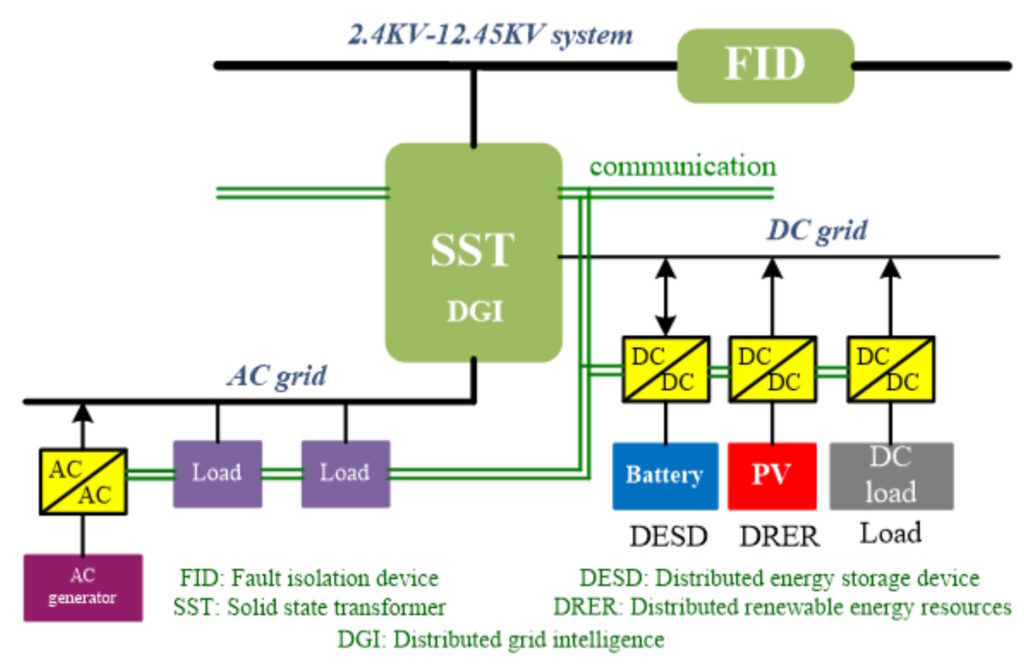
One proposed configuration that can be adapted for green energy or data center applications can operate in SST-enabled mode or islanding mode. The SST architecture can support AC and/or DC grid-interactive microgrids (Figure 2).
Sidecars side-lined by SSTs
Dedicated sidecar power racks in hyperscale data centers have been developed to supply the MW power demands of AI processing clusters anticipated by the Open Compute Project. That marks a temporary solution as SST technology is developed (Figure 3).
- Sidecar racks replace the power conversion and backup power previously in the bottoms of server racks by adding a dedicated rack for power functions next to the server rack. Sidecars are designed to support the latest 800 Vdc power architectures, enhancing the power density and supporting the ballooning power needs of server racks.
- Replacing the sidecar with SSTs will free up additional white space for more computing racks. Initial SST installations are expected to occur in the so-called grey space with other data center infrastructure, or the black space where the data center connects with external networking and power resources. Initially, the SST will power the sidecars through an 800 Vdc bus. In the longer-term, sophisticated SSTs will eliminate the need for sidecars.
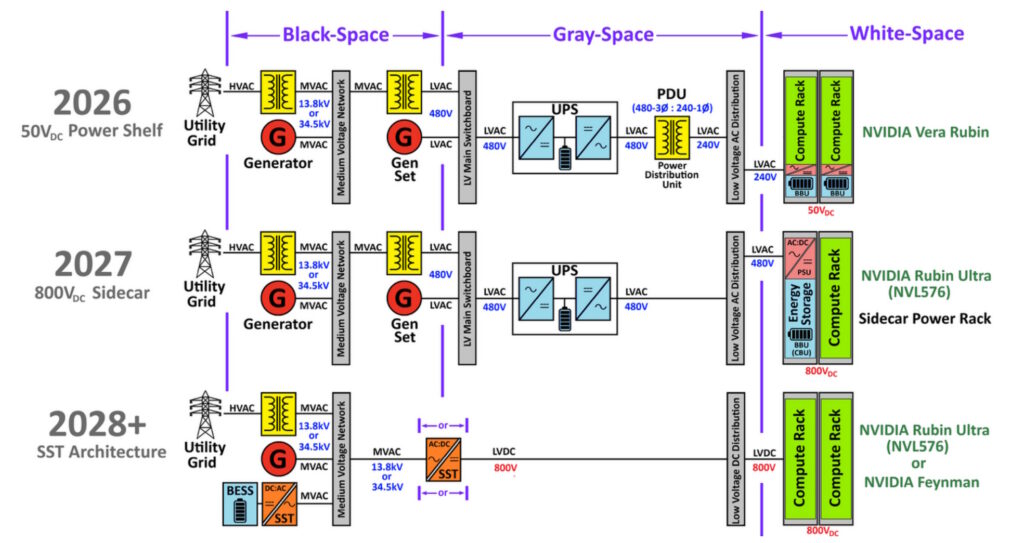
In the final stage of the evolution, a battery energy storage system (BESS) located outside the building replaces a traditional UPS. Replacement of the sidecar power and the UPS both depend on SST technology with fast-enough transient response capabilities to handle the widely dynamic loads inherent with the AI processing in hyperscale data centers. AI algorithms can track the millisecond-by-millisecond power swings of AI workloads, especially during training, and dynamically adjust power flow to support optimal GPU operation.
Summary
The symbiosis between AI and SSTs enables each technology to improve the operation of the other. AI can enhance SST efficiency, flexibility, and resilience in a range of applications like EV charging and green energy microgrids. AI-enabled SSTs can improve AI training and inference efficiency, enable higher compute densities, and integrate green energy resources with hyperscale AI data centers.
References
800-VDC Data Centers and the Central Role of Solid-State Transformers, DG Matrix
A Blueprint for 800 VDC Datacenters Standardize the Block, Accelerate the Build: 12 MW IT Block for the AI Era, Heron Power Electronics
AI, Solid State Transformers For The Modern Power Grid, Peak Nano
Infinity Flow Achieves Major Milestone: New Version of AI-Based Control Algorithm for Solid-State Transformer Technology Successfully Validated, Infinity Flow
Intelligent power for AI, Enphase Energy
Meeting Increasing Energy Demands with Solid-State Transformers, Infineon
Powering AI with reliable silicon carbide-based solid-state transformers, Wolfspeed
Solid State Transformer (SST) FREEDM architecture, NC State University
Solid-State Transformers and 800 VDC: What AI Data Centers Are Really Preparing For, MoonShot
Speed-to-AI Power as a Competitive Advantage Enabled by Solid-State Transformers, DG Matrix
Why Solid-State Transformers Are Becoming a Must-Have for AI-Powered Architectures—And Why NVIDIA Is Leading the Charge, JSD Transformer
Related EEWorld Online content
What is a solid-state transformer?
How is power limiting the adoption of physical artificial intelligence in humanoid robotics?
How does the IEEE MagNet Challenge use AI for power magnetics modeling?
How do ML and AI work in power conversion? part 1
How is physical artificial intelligence used to optimize data center efficiency?